
Coffee lines moved slower while wages climbed and venues stayed dark overnight, yet demand for espresso never slept, pushing operators to seek machines that could pour with barista finesse without calling in sick or turning off the lights. That search led to AI-enabled robotic coffee kiosks—and to Anno Robot, a Shenzhen-based firm arguing that precision robotics supervised by algorithms and glued together by IoT can do more than vend; it can deliver café-grade beverages, reliably, all day and all night.
The Context: Labor, Consistency, and Always-On Demand
Hospitality faced a stubborn equation: fewer baristas, rising labor costs, and customers expecting service at 2 a.m. as readily as at 2 p.m. This combination did not just pressure margins; it undermined the core promise of modern retail—speed, quality, and convenience everywhere. Automation stepped in not as a gimmick, but as a control system for volatility.
Anno Robot positioned its answer within that shift, contending that a robotic barista can standardize technique and remove the soft edges that make a cappuccino sublime one minute and mediocre the next. Moreover, by embedding connectivity, the company promises operators something brick-and-mortar cafés could never quite achieve: networked control of quality, maintenance, and promotions across dispersed locations with minimal staffing.
What the System Is: Robotics, AI, and IoT in Concert
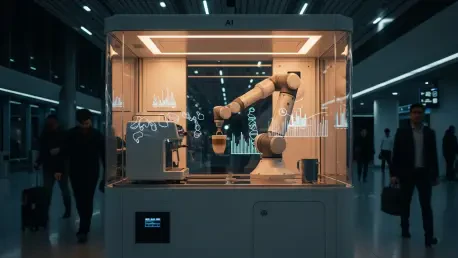
At its core, Anno Robot’s platform merges a six-axis robotic arm with AI-driven brewing control and a cloud layer for fleet oversight. The arm provides dexterity and repeatability—essential for dosing, tamping, extraction, and milk handling. The AI layer measures and adjusts variables such as grind size, temperature, pressure, and timing to keep every shot within a narrow band of target profiles.
IoT ties it together with telemetry streams on machine health, inventory levels, sales velocity, and error states. This stack matters because it breaks the historical compromise between speed and craftsmanship. Instead of pre-ground coffee and generic recipes, the system continually tunes process parameters, treating beverage preparation as a closed-loop control problem rather than a fixed script.
How It Works: From Grinding to Latte Art
Brewing starts with sensors watching throughput and resistance to infer grind drift and puck density. If humidity shifts or a batch of beans behaves differently, the controller tweaks the grinder and pre-infusion to stabilize extraction. Temperature and pressure ramps are modulated shot by shot, balancing sweetness and clarity—a method similar to high-end manual profiles but executed mechanically and consistently.
Milk is frothed through programmed steam routines guided by temperature and flow feedback, then poured by the arm in arcs that replicate latte art passes. The machine’s value is not the novelty of a robot pouring tulips; it is the reduction of variance between 9 a.m. and 9 p.m. when staff fatigue, turnover, and crowding would typically erode quality. Claims of 98% consistency function as a proxy for that variance reduction; while the testing basis was not disclosed, the control approach supports less drift than human-only workflows.
Remote Operations: Fleet Management and Predictive Care
From a dashboard, operators watch real-time sales and stock levels, push menu updates, rotate promotions by venue, and receive alerts before failures cascade. Vibration anomalies on pumps, steam tip fouling patterns, or unusual shot durations trigger work orders or software nudges. Predictive maintenance matters because field service is the hidden tax on any hardware rollout; catching wear early extends uptime and lowers truck rolls.
Remote configuration also reframes training. Instead of teaching each site advanced barista skills, staff learn replenishment and sanitation routines in short sessions, while recipe logic remains centralized. That design compresses onboarding to around 90 minutes, if the company’s claim holds, and shifts complexity from the edge to the cloud, where updates scale.
Formats and Fit: Bars, Kiosks, and Mobility
Anno Robot splits its lineup into open-style bars, enclosed intelligent kiosks, and specialized latte art stations. Open bars turn the robot into theater for malls, campuses, and tourist venues; the glass and motion amplify discovery and encourage impulse orders. Enclosed kiosks trade spectacle for resilience—weather sealing, access control, and environmental conditioning fit airports, hospitals, and outdoor placements.
Mobility is a strategic lever. Units can be relocated with minimal downtime, allowing operators to follow foot traffic, support pop-ups, or ride seasonal surges. This “overnight mobility” reduces location risk: if a corridor underperforms, the asset moves rather than idles. Competitively, that fluidity differentiates robotic kiosks from built-in café counters that require renovations to pivot.
Safety and Hygiene: Design for Trust
Automated handling inside an enclosed workspace reduces human touchpoints, supporting post-pandemic preferences for contact-minimized prep. Materials and surfaces are selected for food safety and cleanability, and the company cites ISO, CE, and FCC credentials as proof of compliance across markets. These badges carry weight because unattended retail must clear both food and electrical standards, often with region-specific nuances.
Sanitation remains the critical dependency. Automated prompts and guided wash cycles help, but adherence is operational, not algorithmic. Compared with competitors, the tighter integration of enclosure, process control, and remote alerts should reduce risk, yet outdoor sites and 24/7 duty cycles will still demand disciplined cleaning and consumable swaps to maintain cup quality and regulatory confidence.
Performance and Quality: Consistency in the Cup
The pitch is café-grade results at scale, including textured milk and repeatable latte art. In practice, consistency rests on three pillars: ingredient quality, water chemistry, and mechanical state. AI can compensate for drift in grind and pressure, but poor beans or neglected filters will cap outcomes. Where the platform excels is maintaining a house profile across dozens of machines; repeat customers get the taste they expect, regardless of venue.
Throughput is the counterweight. Robotic choreography and milk routines take time, and peak-hour queues may stretch if demand spikes beyond the arm’s cycle rate. The platform’s strength is off-peak capture—early mornings, late nights, and venues with steady trickles rather than tsunami rushes. Operators aiming to replace a high-volume café line should model peak concurrency carefully or deploy multiple units.
Economics: Costs, ROI, and Site Sensitivity
The boldest claim is up to 70% operating expense reduction versus traditional cafés. Interpreted, this reflects labor offsets, smaller footprints, and fewer build-outs, balanced against capital cost, service contracts, utilities, and ingredients. ROI hinges on traffic density and dwell time; airports and hospitals with 24/7 flows are fertile, while low-traffic corridors risk underutilization.
Mobility and modular menus add economic resilience. By extending into cocktails or ice cream, the same hardware can monetize different dayparts, boosting revenue per square foot. However, every added category introduces cleaning complexity, new permits, and replenishment logistics. The platform approach is compelling, but the operational plan must price in category-specific overhead to preserve margins.
Competitive Landscape: Why This and Not Others
Many automated coffee systems exist, from superautomatic machines behind counters to enclosed vending bays. Anno Robot’s edge lies in integrating six-axis motion for visible craft, closed-loop brewing control for precision, and cloud tools for fleet-level orchestration. The latte art station, in particular, targets experiential retail where presentation drives conversion and social share.
Two other differentiators matter for buyers: certifications for global deployment and a stated lifetime maintenance commitment. If fulfilled, the latter reduces long-term support anxiety that dogs hardware startups. Competitors may match individual features—good grinders, telemetry, or reliable steam—but fewer present a cohesive, multi-category platform with mobility and barista-grade showmanship in one stack.
Risks and Unknowns: Where the Proof Still Needs Data
Unattended retail faces practical threats: vandalism outdoors, payment fraud, and region-specific permitting. Kiosk hardening and compliance consulting help, yet they do not erase the need for site surveys and insurance. Data privacy is another frontier; telemetry and preference tracking cross borders with varied rules, so operators must validate data handling and storage practices for each market.
Quality control also depends on maintenance cadence. Even with predictive signals, milk lines require cleaning, grinders need burr changes, and seals wear under continuous duty. The 98% consistency figure is promising, but the metric should be anchored by sensory panels and extraction analytics across climates and ingredient sets. Pilot programs with transparent KPIs will separate engineering promise from operational reality.
Verdict: What Operators Should Do Next
Taken as a whole, Anno Robot’s kiosks blended credible robotics, adaptive brewing control, and IoT oversight into a platform that targeted the sector’s pain points—labor scarcity, variability, and off-peak coverage—while adding experiential pull through visible automation. The multi-format lineup and mobility strengthened the business case, and the emphasis on certifications and remote service reduced adoption friction. Yet returns still turned on local conditions: traffic profiles, cleaning discipline, and regulatory fit.
The most pragmatic next step had been structured pilots in two contrasting venues—a high-visibility indoor site for engagement and a 24/7 corridor for throughput—instrumented with clear goals: average cycle time, cup-to-cup variance, downtime, and cost per drink after service fees. Menu expansion beyond coffee should have been staged, proving hygiene workflows before layering cocktails or ice cream. Where results confirmed the claimed consistency and uptime, scaling a fleet with centralized recipe control and predictive maintenance would have made strategic sense; where peak queues exposed limits, deploying additional units or narrowing the menu during rush windows would have preserved experience without eroding margins. In short, the technology earned a positive verdict for operators seeking reliable, always-on beverage service, provided decisions were grounded in site-specific data and disciplined operations.