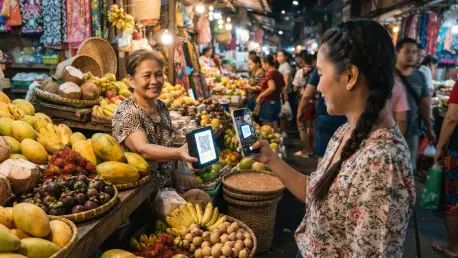

The Philippine financial landscape currently stands at a critical juncture where the rapid adoption of digital tools must finally be matched by a seamless and reliable user experience to ensure long-term stability. While the nation has successfully pushed digital payments to represent over sixty-four percent of total transaction volume by the start of 2026, a significant underlying challenge persists regarding the quality of these interactions. Merely providing access to digital wallets and online banking platforms is no longer sufficient for a population that increasingly demands efficiency and immediacy. The discrepancy between the high volume of small-scale retail payments and the lagging value of total digital transfers suggests a lingering hesitation among consumers to fully commit their financial lives to the cloud. To reach the national target of seventy percent of all retail payments being digital by 2028, institutions must prioritize the elimination of systemic friction that currently discourages users from abandoning cash.
Understanding the Disconnect Between Volume and Total Value
As of 2026, the Philippines has demonstrated a remarkable appetite for digital convenience in the micro-payment sector, yet the total value of these transactions tells a more complex story. Despite a surge to nearly four billion digital transactions annually, the total value share of these payments recently dipped to approximately fifty-three percent, indicating that cash remains the preferred medium for larger, high-stakes financial commitments. This trend reveals a fundamental lack of deep-seated trust in the digital infrastructure for significant purchases, such as vehicle payments or large-scale business invoices. Consumers frequently worry about the finality and security of high-value transfers when they encounter technical lags or opaque processing times. Consequently, the transition to a truly digital economy requires more than just high-frequency engagement; it necessitates a robust framework where users feel as confident moving millions of pesos as they do paying for a simple cup of coffee at a local cafe.
Eliminating the technical friction that currently plagues the banking sector is the most immediate hurdle for financial institutions aiming to capture this missing market value. Common grievances often include slow-loading QR codes at merchant terminals, unexpected processing delays during peak hours, and a lack of real-time confirmation for peer-to-peer transfers. These small annoyances aggregate into a significant deterrent that prevents the elderly and rural populations from fully embracing digital finance. By emulating the success of regional neighbors or global leaders like India, where digital payment systems are characterized by extreme reliability and speed, Philippine banks can begin to bridge this gap. The objective for the period from 2026 to 2028 must be the creation of an ecosystem where digital tools are not just an alternative to cash, but the demonstrably superior choice for every transaction type, regardless of the amount involved or the technical literacy of the user.
Refining Conflict Resolution and the Service Gap in ASEAN Banking
The regional competitive landscape highlights a pressing need for the Philippines to overhaul its approach to customer service quality within the financial services industry. Currently, the nation holds a customer experience score of 3.77, which significantly trails behind the benchmarks set by regional peers such as Singapore, Malaysia, and Vietnam. This service gap is most pronounced in the area of conflict resolution, where users often face long wait times and unresponsive support channels when a transaction fails or an error occurs. When a digital payment goes awry, the psychological impact on the consumer is much greater than a physical transaction failure, often leading to a total loss of trust in the platform. To improve these scores, banks must invest heavily in streamlining their grievance redressal mechanisms, ensuring that automated systems do not become barriers to human assistance. Reducing the time it takes to resolve a dispute is the single most effective way to improve the national average and foster loyalty.
Integrating human-centric artificial intelligence represents a sophisticated solution to these persistent service bottlenecks, allowing for a balance between efficiency and empathy. While AI excels at handling mundane, repetitive tasks—such as processing credit limit increases or answering basic balance inquiries—it must not be used as a shield to hide from complex customer problems. The future of successful banking in the Philippines lies in a hybrid model where technology handles the heavy lifting of data processing, yet human experts are instantly available to manage sensitive financial disputes. This approach ensures that the “human touch” is preserved when it matters most, preventing the alienation of customers who may already feel intimidated by rapid technological shifts. As the industry moves closer to the 2028 goals, the successful implementation of AI will be measured not by how many humans it replaces, but by how effectively it empowers service representatives to provide faster, more accurate, and more compassionate assistance to every Filipino account holder.
Building a Reliable and Inclusive Ecosystem for Future Growth
Achieving a truly inclusive digital ecosystem requires a strategic focus on segments of the population that have traditionally been underserved by the modern banking sector. This includes residents in remote rural areas where internet connectivity may be intermittent, as well as the elderly who may struggle with complex user interfaces. For digital payments to reach seventy percent of all transactions by 2028, the infrastructure must be resilient enough to handle diverse environmental and social challenges. Banks should look toward simplifying the user journey by designing interfaces that are intuitive and localized, reducing the cognitive load required to complete a transaction. Furthermore, financial literacy programs must be integrated directly into the digital experience, educating users on security best practices while they navigate their accounts. By fostering an environment of transparency and accessibility, the financial sector can ensure that no citizen is left behind as the nation transitions away from a paper-based economy toward a more efficient digital future.
The strategic shift toward prioritizing customer experience proved to be the most vital component in the evolution of the Philippine digital payments landscape. Rather than focusing solely on technological deployment, successful institutions recognized that human-centric design was the key to unlocking the full potential of the national retail market. The industry moved beyond simple transaction metrics to analyze the emotional and psychological drivers of consumer trust, which eventually stabilized the value of digital transfers across all demographic groups. Actionable steps involved the implementation of real-time dispute resolution protocols and the refinement of AI-driven support that prioritized immediate human intervention for high-value issues. These initiatives collectively addressed the friction points that once hindered widespread adoption, creating a foundation for a more resilient financial system. By the time the industry looked toward its next set of milestones, the standard for banking had been redefined as a blend of high-tech efficiency and deep, reliable human empathy.