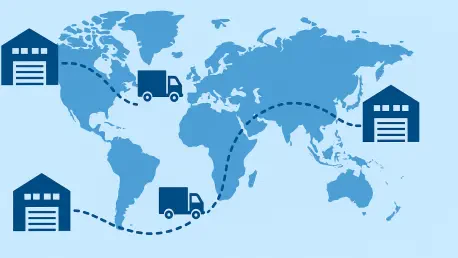

Managing the immense friction within a global supply chain that moves twenty-three million orders annually requires more than just human intuition; it demands a radical departure from traditional logistics. Unilever has moved past the era of manual spreadsheet management and reactive troubleshooting by redesigning its foundational operations. With a catalog of 70,000 products distributed from 200 warehouses, the logistical scale is staggering, yet the company has turned this complexity into a competitive advantage. The consumer goods giant is currently refining a digital nervous system that empowers its 6,000-person customer operations team to work with unprecedented speed.
This transformation is not merely about incremental improvements but represents a fundamental shift in how global business functions. By moving the administrative weight from humans to autonomous agents, the company is pioneering a “no-touch” operational model where technology acts as a proactive participant in the value chain. This strategic pivot ensures that the organization remains resilient against market volatility while maintaining a razor-sharp focus on the needs of over 200,000 global customers.
From Massive Logistics to Intelligent Orchestration
While many global corporations are still experimenting with basic chatbots, Unilever has quietly redesigned the backbone of its global supply chain. Managing such a vast volume of orders once required a small army of administrative personnel and endless manual data entry. Today, the consumer goods giant is shifting the burden of complexity from human operators to agentic systems that do not just suggest actions but execute them autonomously. This transition marked a departure from traditional reactive logistics toward a no-touch operational model where AI acts as a primary driver of the value chain.
The move toward intelligent orchestration allows the company to handle 23 million annual orders with a level of precision that was previously impossible. These systems are capable of identifying patterns across millions of data points, allowing for real-time adjustments that human operators could not perform manually. This evolution has effectively removed the bottleneck of human processing speed, creating a more fluid and responsive network that adapts to customer needs as they arise.
The Strategic Necessity of Digital Evolution
The scale of Unilever’s operations reached a point where human-led manual processes could no longer keep pace with global market volatility. In an era defined by rapid fluctuations in demand and supply chain disruptions, the company recognized that growth required a fundamental shift in structure. By consolidating customer operations into a centralized, data-driven engine, Unilever laid the groundwork for a digital transformation that connects material procurement directly to real-world consumer behavior.
The financial stakes of this evolution are significant, with €45 billion of turnover now influenced by AI-driven forecasting. This technology is no longer a peripheral experiment but a core driver of the company’s financial health and operational stability. By integrating digital intelligence into the heart of the business, Unilever has ensured that its supply chain can absorb shocks while continuing to deliver value to its global stakeholders.
Navigating the Roadmap: From Prediction to Autonomy
Unilever’s journey toward total digital integration followed a logical progression, moving from simple data analysis to autonomous execution. The first major milestone involved the implementation of machine learning-based regression models to enhance forecasting accuracy. By analyzing historical data and market trends, these predictive models allow the company to synchronize factory schedules and outputs with precision. This phase proved that AI could handle the heavy lifting of data interpretation, providing a baseline for the more advanced stages of the digital roadmap.
The current frontier is the deployment of agentic AI, characterized by systems that navigate complex workflows independently. A primary example is Nova, a flagship AI agent currently being scaled for the North American market. Unlike traditional software, Nova can ingest unstructured data—such as order requests buried in emails—interpret the context, and autonomously input the information into the SAP operating system. This capability extends to managing complex claims and dispute resolutions, effectively closing the loop on administrative tasks without human intervention.
A Rigorous Framework for Global Scalability
To measure the effectiveness of these agents, Unilever utilizes a no-touch percentage as its primary Key Performance Indicator. This metric tracks the degree to which a process is completed from start to finish without manual interference. Currently, forecasting has reached a 60% no-touch rate, while specific planning processes have achieved 90% automation. This data-driven benchmark allows leadership to identify exactly which parts of the supply chain are ready for full autonomy and which require further refinement.
Unilever ensures that its technological advancements are not siloed by adhering to a strict three-pillared strategy designed for global consistency. Before any AI tool is deployed, the company creates a digital twin of the global process design. This involves documenting specific taxonomies to ensure that a process in Europe follows the same logic as one in North America. This standardization allows leadership to treat regional deviations not as errors, but as data points to identify underlying operational inefficiencies.
Empowering the Human Element Through DigiOps
As AI agents assume the burden of rote calculations and data entry, the role of the human employee is being fundamentally redefined. The shift to agentic AI has allowed planners to transition away from manual spreadsheet management toward strategic oversight. These employees are now end-to-end flow orchestrators, focusing on high-level strategic optimization and value chain resilience rather than granular data manipulation. This elevates the workforce from administrative support to strategic architects.
To combat the natural hesitation associated with AI adoption, Unilever launched the DigiOps program, providing 150 hours of on-the-job training over nine months. Data showed a direct correlation between the number of DigiOps graduates in a region and the successful adoption rate of new AI tools. This initiative proved that upskilling is the essential bridge between technological potential and operational ROI, ensuring that employees are prepared for the future of work.
Balancing Centralized Governance: Sandbox Innovation
Unilever employed a dual-track approach to innovation, ensuring security for core systems while fostering creativity at the individual level. For massive, high-impact projects like the Nova agent, the company maintained rigid central governance. These tools underwent extensive validation and followed a structured global rollout plan to protect the integrity of the core operating systems and data security. Simultaneously, the organization encouraged a sandbox mentality for personal productivity. Nearly 2,000 employees were trained to build their own utility agents within a secure cybersecurity framework.
The next phase of this evolution focused on the deep integration of these agents into the wider circular economy to minimize environmental impacts. Leaders identified that the true value of agentic systems lay in their ability to predict resource scarcity before it impacted the production line. By the time global market shifts occurred, the no-touch architecture already adjusted supply routes and redirected inventory without human intervention. This proactive stance suggested that the future of customer operations belonged to those who successfully merged human oversight with autonomous execution. The initiative proved that operational excellence was no longer about managing people, but about orchestrating a digital workforce that functioned with relentless precision.