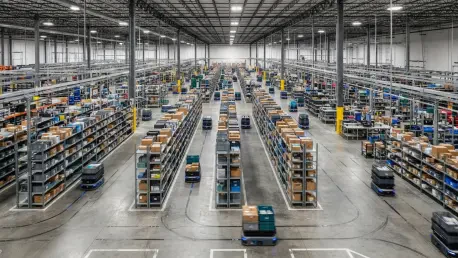

The sheer velocity at which global trade currently operates has fundamentally transformed the humble storage warehouse into a high-stakes, technology-driven nerve center that dictates the ultimate success or failure of modern commerce. No longer viewed as isolated islands of inventory, today’s distribution centers act as high-velocity fulfillment hubs within a sophisticated global network. This transition has necessitated a move toward integrated ecosystems where the movement of goods is synchronized with digital data flows. The traditional model of static storage has been replaced by a fluid environment that prioritizes speed, accuracy, and total visibility.
The convergence of cloud computing and IoT sensors serves as the technological foundation for this new era. By integrating Warehouse Management Systems (WMS) with Enterprise Resource Planning (ERP) and Transportation Management Systems (TMS), companies have achieved a level of synergy that was previously unattainable. This connectivity allows for a seamless exchange of information, ensuring that every stakeholder in the supply chain is informed of inventory changes in real time. The influence of market leaders and the pervasive “Amazon Effect” have established new industry benchmarks, forcing even small-scale operators to adopt advanced digital strategies to remain relevant in a competitive landscape.
Economic and geopolitical shifts have further elevated the strategic importance of warehouse efficiency. In an age where trade resilience is synonymous with national stability, the ability to manage disruptions through agile warehousing has become a primary focus for policymakers and corporate boards alike. Efficiency within the warehouse now dictates the flow of international trade, making the selection of software and hardware a decision with far-reaching economic consequences. As businesses navigate these complex waters, the focus has shifted from simple storage toward the creation of a resilient, technology-first infrastructure.
Shifting Landscapes in the Global Logistics and Distribution Industry
The definition of a modern warehouse has expanded far beyond the physical four walls of a building. Today, these facilities are dynamic nodes in a global web, designed to handle high volumes of individual orders rather than bulk shipments. This shift is driven by the demand for instant gratification and the complexity of global sourcing, requiring facilities to operate with surgical precision. To maintain this pace, the modern ecosystem relies on a decentralized architecture where inventory is positioned closer to the end consumer, reducing transit times and logistics costs.
The core technological pillars supporting this change are centered on the elimination of information gaps. Cloud-based WMS platforms provide the scalability needed to handle seasonal peaks, while IoT sensors offer granular data on everything from temperature to shelf life. When these tools converge with ERP and TMS platforms, the result is a unified command center. This integration ensures that a warehouse manager can see not just what is on the racks, but what is arriving via inbound freight and what has been promised to customers across multiple continents.
Market dominance in this sector is currently held by a few major software providers who have successfully navigated the transition to cloud-first models. These players have set the standard for what a WMS should provide, emphasizing user-friendly interfaces and robust data analytics. The ripple effect of these advancements is felt across the entire economy, as optimized warehouses lower the cost of living by reducing the overhead associated with consumer goods. Consequently, the warehouse is no longer a back-office concern; it is a front-line driver of corporate profitability and economic health.
Current Market Dynamics and the Trajectory of Innovation
Emerging Trends Reshaping Modern Distribution
The most significant shift in distribution is the transition away from static, historical data toward real-time, event-driven responsiveness. In the past, managers relied on last year’s figures to predict this year’s needs, but in a volatile market, those metrics are frequently irrelevant. Modern WMS platforms now utilize live data streams to adjust workflows on the fly, responding to sudden spikes in demand or unexpected shipping delays. This move toward “live” logistics ensures that resources are allocated where they are most needed at any given moment.
Omnichannel orchestration has become the new operational standard as the distinction between online and physical retail continues to blur. A unified WMS must now manage inventory across diverse channels, ensuring that a product sold on a mobile app is immediately deducted from the available stock for a physical storefront. This requirement for a single source of truth has pushed companies to abandon fragmented software in favor of platforms that offer 360-degree visibility. Without this level of synchronization, businesses risk stockouts, overstocking, and a degraded customer experience.
Furthermore, the rise of localized micro-fulfillment centers has introduced a era of high-speed delivery. These smaller, often automated facilities are located in urban centers to facilitate same-day shipping, meeting the growing consumer demand for speed. This trend has turned logistics into a competitive weapon, where the ability to deliver a product in hours rather than days justifies higher price points and builds intense brand loyalty. This shift toward localized fulfillment is not just a trend; it is a structural change in how goods are distributed to the modern consumer.
Statistical Insights and Growth Projections
The valuation of the global WMS market continues to climb, with a projected Compound Annual Growth Rate (CAGR) exceeding 15% from 2026 to 2035. This growth is fueled by the rapid digitization of emerging markets and the continued expansion of e-commerce globally. Investment in the sector is no longer limited to software; there is a massive surge in capital expenditure toward robotics and Automated Storage and Retrieval Systems (AS/RS). Companies are recognizing that the return on investment for automation is realized through increased throughput and the reduction of human error.
Key Performance Indicators (KPIs) are also undergoing a significant evolution. While throughput and order accuracy remain vital, new metrics focused on holistic supply chain visibility and sustainability have gained prominence. Management teams now track carbon footprints per shipment and energy consumption per square foot, aligning logistics goals with broader Environmental, Social, and Governance (ESG) mandates. This shift indicates that the industry is maturing, moving from a narrow focus on speed to a broader consideration of long-term operational health and social responsibility.
Navigating Structural and Operational Obstacles
Despite the rapid pace of innovation, many organizations continue to struggle with the legacy of information silos. These silos occur when different departments or regional offices use disconnected software that cannot share data effectively. Breaking down these barriers requires a concerted effort to migrate toward open-architecture platforms that favor interoperability. Without a free flow of information, even the most advanced robotics will fail to reach their full potential, as they will be operating on incomplete or outdated instructions.
The ongoing labor shortage remains a primary hurdle for the logistics industry, particularly in regions with aging populations. Technology is being used as a solution to augment human labor rather than replace it entirely, with cobots (collaborative robots) taking over strenuous or repetitive tasks. This approach not only improves productivity but also enhances worker retention by creating a safer and less physically demanding environment. However, the challenge of training workers to operate these sophisticated systems remains a significant operational burden for many companies.
Data overload presents another unique challenge, as the sheer volume of “noise” generated by millions of sensors can overwhelm decision-makers. Finding actionable intelligence within quintillions of bytes of daily data requires advanced filtering and visualization tools. Moreover, the increased connectivity of modern warehouses has opened new doors for cybersecurity threats. Protecting integrated supply chain nodes from ransomware and data breaches is now a top priority, necessitating robust encryption and continuous monitoring of all digital touchpoints.
The Regulatory Framework and Compliance Standards
Navigating the complexities of global trade compliance has become increasingly difficult as regulations shift in response to geopolitical tensions. Modern WMS platforms must now automate the generation of customs documentation and ensure adherence to diverse international labor laws. This automation is critical for cross-border operations, where a single missing document can lead to costly delays or heavy fines. Compliance is no longer a manual task; it is an integrated feature of the software that manages the warehouse.
Safety and ergonomic mandates have also tightened as human workers begin to collaborate more closely with high-speed robotics. Organizations must adhere to strict international standards to prevent accidents and ensure that the integration of automation does not come at the expense of worker health. This includes the implementation of advanced sensing technologies that allow machines to detect human presence and react accordingly. Compliance in this area is not just about avoiding litigation; it is about fostering a culture of safety that supports long-term operational stability.
Sustainability regulations are beginning to reshape the physical layout and energy consumption of the warehouse. “Green Logistics” mandates now require companies to report on waste management and energy efficiency, pushing the industry toward more sustainable practices. Additionally, data privacy remains a significant concern, especially within integrated cloud-based systems that handle sensitive customer information. Adhering to standards like GDPR is mandatory, requiring WMS providers to build privacy-by-design into their platforms to ensure that data is protected at every stage of the journey.
The Future of Warehouse Intelligence and Network Integration
The next frontier of warehouse management lies in AI-driven predictive orchestration. Neural networks are being trained to anticipate demand signals from unconventional sources, such as social media trends, local weather patterns, and even global economic shifts. This allows the WMS to preposition inventory before a customer even places an order. This level of foresight transforms the warehouse from a reactive facility into a proactive engine of commerce, minimizing the time between order placement and delivery.
Hyper-automation is leading toward the reality of “lights-out” warehousing, where facilities can operate autonomously for extended periods. In these environments, human-machine collaboration reaches peak efficiency, with people focusing on high-level strategy and maintenance while robots handle the physical movement of goods. This transition does not eliminate the need for human oversight but shifts the focus toward managing the systems that manage the inventory. The result is a dramatic increase in operational capacity and a reduction in operational costs.
Blockchain technology holds the potential to provide end-to-end transparency across the entire supply chain. By creating an immutable ledger of every transaction and movement, blockchain ensures that the origin and journey of every product are verifiable. This is particularly important for industries like pharmaceuticals and luxury goods, where authenticity and chain-of-custody are paramount. As these technologies mature, the next generation of WMS will prioritize agility and resilience over lean efficiency, ensuring that the supply chain can survive and thrive despite global disruptions.
Synthesis of the Integrated Supply Chain Evolution
The strategic shift from localized storage to centralized intelligence nodes proved to be the defining characteristic of the industry’s evolution. Organizations that embraced the transition from the traditional “four walls” model to a globally integrated hub system successfully navigated the volatile markets of the past few years. This transformation was not merely about purchasing new software; it represented a fundamental reimagining of how goods moved through space and time. The integration of WMS, TMS, and ERP platforms created a unified digital nervous system that provided the agility required for modern commerce.
Stakeholders who prioritized technology investments and fostered a culture of digital transformation realized significant gains in both efficiency and resilience. The reliance on real-time data and AI-driven insights allowed businesses to pivot quickly in the face of unforeseen challenges, while automation mitigated the impact of labor shortages. Ultimately, the industry moved toward a future where the warehouse became the most critical link in the value chain. Those who recognized this early and invested in integrated, sustainable, and secure systems secured their position at the forefront of the global economy.