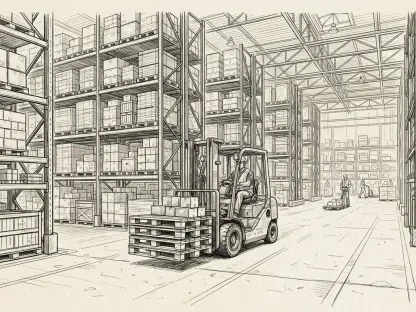

The seamless integration of digital perception into the tactile reality of manual labor has fundamentally altered the paradigm of how global enterprises manage their most complex operational workflows. Unlike the previous wave of artificial intelligence that focused on generating text or images, physical AI bridges the gap between digital intelligence and tangible movement. This evolution facilitates a transition where technology supports manual labor rather than merely automating clerical tasks. By embedding intelligence directly into the workspace, industries are seeing a shift toward environments where humans and machines operate as a single, cohesive unit.
Introduction to Physical AI and Spatial Intelligence
Physical AI represents the next frontier of automation, moving beyond the digital “knowledge work” of the past decade into the physical realm. This technology relies on the ability of a system to perceive, interpret, and react to a dynamic environment in real time. It is not about replacing the worker but providing them with a digital layer of awareness that was previously impossible to maintain at scale.
This transition is particularly relevant as global industries face labor shortages and increasing logistical complexity. By converting the physical actions of a worker into actionable data, organizations can identify inefficiencies that were once invisible. This context provides a foundation for a more responsive and intelligent industrial landscape where data flows as freely as physical goods.
Core Components of Physical AI Systems
Wearable AI-Powered Computer Vision
One of the primary drivers of this technology is the use of wearable, AI-powered cameras that capture data through the eyes of the worker. Unlike stationary sensors, these wearable devices move with the individual, providing a first-person perspective on store shelves and assembly lines. This ensures that the AI sees exactly what the human sees, allowing for precision monitoring without the need for an invasive overhaul of existing infrastructure.
Moreover, these cameras process visual data locally or via low-latency networks to provide immediate feedback. By analyzing visual cues in real time, the system can alert a worker to a misplaced item or a safety hazard instantly. This direct feedback loop streamlines operations and reduces the cognitive load on employees, allowing them to focus on high-level problem-solving rather than routine checks.
Integrated 3D Spatial Awareness
The system’s ability to understand 3D space, objects, and human movement simultaneously is what separates physical AI from traditional computer vision. By mapping the environment in three dimensions, the technology identifies the depth and orientation of objects relative to the worker. This spatial intelligence is crucial for navigating crowded retail aisles or cluttered factory floors where traditional 2D cameras often fail.
Furthermore, this awareness extends to understanding intent and motion patterns. The technology can distinguish between a worker simply walking past a shelf and one who is actively restocking it. This nuance ensures that the data collected is accurate and that the digital twin of the physical environment remains perfectly synchronized with reality at all times.
Recent Innovations and Market Momentum
The influx of capital into startups like Augmodo, which recently secured $21 million in funding, highlights the significant market momentum behind this sector. With a valuation reaching $350 million, investor confidence suggests that proprietary physical AI models are becoming high-value assets. This financial backing allows for the rapid scaling of engineering teams and the refinement of complex spatial models that can operate across various industrial settings.
This momentum also reflects a shift in industry behavior toward human-centric AI models. Rather than focusing on total automation, companies are investing in tools that enhance human productivity. High-market valuations act as an indicator that the industry perceives manual labor augmentation as a more viable and scalable path than the development of fully autonomous humanoid robotics in the near term.
Real-World Applications Across Industrial Sectors
Precision Inventory Management in Retail
In the retail sector, physical AI has revolutionized how inventory is tracked and managed. Real-time shelf monitoring allows employees to identify stockouts the moment they occur, ensuring that consumer demand is always met. This application significantly reduces the time workers spend on manual audits, shifting their focus toward customer service and store organization.
Additionally, the technology provides retailers with deep insights into shopper behavior and product placement effectiveness. By analyzing how workers interact with inventory, the system generates heat maps and movement data that inform better store layouts. This data-driven approach transforms the retail floor into an optimized environment where every shelf is managed with surgical precision.
Complex Industrial and Automotive Assembly
Beyond retail, spatial intelligence is finding critical use cases in complex manufacturing and automotive assembly. In these environments, the AI identifies specific tools and components, ensuring that every step of a complex workflow is followed correctly. This is particularly useful for managing the assembly of intricate machinery where a single missed bolt can lead to significant safety or quality issues.
The system also aids in training and quality control by providing real-time guidance to technicians. If a worker picks up the wrong tool for a specific task, the AI can provide a haptic or visual alert. This layer of digital oversight ensures that high standards of precision are maintained even in high-pressure production environments, effectively bridging the gap between novice and expert performance.
Technical and Regulatory Challenges
Operating in dynamic, real-world environments presents several technical hurdles, particularly regarding data processing speeds. Physical AI systems must process vast amounts of visual data with minimal latency to be effective. As these systems scale, the demand for edge computing power increases, requiring significant investments in hardware and network infrastructure to maintain performance.
On the regulatory side, the integration of wearable cameras into labor frameworks introduces complexities regarding worker privacy and data security. Organizations must navigate the legal landscape of continuous data collection while ensuring that the technology is used ethically. Balancing these operational benefits with the rights of the workforce remains a primary concern for developers and enterprise leaders alike.
Future Outlook and the Human-Centric Shift
The future of this technology lies in a shift toward empowering the workforce through advanced digital tools rather than replacing it. Upcoming industry events, such as the focus on AI at the Innovation Awards, will likely showcase even more sophisticated integrations of spatial intelligence into daily labor. This trend suggests that the most successful enterprises will be those that view their people as their most valuable asset, augmented by digital perception.
Looking ahead, the expansion of physical AI into global enterprise markets will likely lead to a new standard for operational transparency. As models become more lightweight and efficient, we can expect to see this technology in smaller convenience stores and specialized workshops. The long-term impact will be a more resilient global supply chain where human intuition and machine precision are inextricably linked.
Summary and Final Assessment
The review of physical AI established that the technology functioned as a vital bridge between human capability and digital precision. It demonstrated that augmenting workers was a more sustainable path than full automation in diverse sectors like retail and manufacturing. Enterprises that adopted these tools secured a competitive advantage by turning their physical workspace into a responsive data network. The integration of 3D spatial awareness and wearable vision provided a level of oversight that previously existed only in digital environments. Ultimately, the development of human-centric AI models proved that the most significant technological breakthroughs occurred when tools were designed to enhance, rather than replace, the human element of manual labor. This approach redirected the focus of the global market toward a more integrated and efficient future.