
High-speed sports environments are increasingly abandoning the traditional checkout line in favor of seamless, invisible payment infrastructures that prioritize fan engagement over administrative hurdles. The integration of autonomous systems into the sports and entertainment landscape marks a pivotal departure from conventional service models that relied on manual intervention. At the heart of this shift is the concept of frictionless commerce, which utilizes a sophisticated orchestration of hardware and software to eliminate the physical point-of-sale. This evolution is not merely about convenience; it represents a fundamental re-engineering of the retail environment to accommodate high-density foot traffic without the bottleneck of human processing.
Emerging from specialized pilot programs, these systems have matured into robust architectures capable of handling hundreds of simultaneous transactions. The relevance of this technology is underscored by the broader push toward automation in smart cities, where efficiency is paramount. By removing the friction of waiting, operators can maximize revenue during short windows of opportunity, such as halftime or pre-game rushes.
The Foundations of Frictionless Commerce
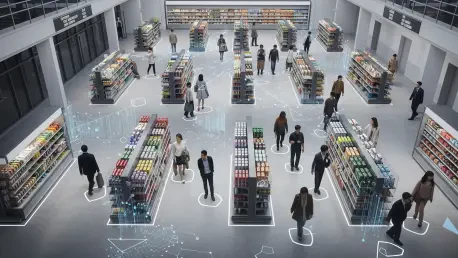
The architectural backbone of modern frictionless stores relies heavily on advanced computer vision arrays that monitor customer movement with surgical precision. Overhead cameras do not simply record video; they utilize machine learning algorithms to create three-dimensional representations of the retail space, identifying which individuals interact with specific shelves. This sensor fusion approach ensures that the system maintains a consistent chain of custody for every item from the moment it is handled.
Performance in these environments has reached a level where rapid movements or crowded aisles no longer paralyze the system’s ability to track inventory. By blending visual data with weight sensors on shelves, the platform achieves high accuracy rates that rival traditional scanning methods. This synergy between diverse sensor types allows the system to distinguish between a customer returning an item to the wrong spot and a genuine selection.
Essential Components of the Autonomous Shopping Experience
Computer Vision and Sensor Fusion Systems
Beyond visual tracking, the implementation of Radio Frequency Identification (RFID) and specialized AI tagging has revolutionized how smaller or more complex products are managed. RFID tags provide a digital fingerprint for each unit, allowing the system to verify the contents of a customer’s virtual basket without direct line-of-sight. This is particularly effective for apparel or high-value merchandise that might be obscured from overhead cameras.
The AI models driving these systems are trained on massive datasets to recognize packaging changes, varied lighting conditions, and diverse human behaviors. This intelligence layer interprets the physical actions of grabbing or placing items, converting movement into financial data in real-time. This level of technical sophistication ensures that the checkout process is not just hidden, but effectively automated from selection to payment.
AI-Driven Product Identification and RFID Tracking
While Amazon has fine-tuned its Just Walk Out technology, the market is witnessing a tactical pivot in how these systems are deployed across different sectors. There has been a noticeable shift toward specialized environments like sports stadiums and airports, where the premium on time justifies the higher infrastructure investment. In contrast, massive grocery chains have recently scaled back some cashierless initiatives in favor of hybrid models that balance automation with human oversight.
This shift reflects a deepening understanding of consumer psychology and operational costs. For a fan at a stadium, saving five minutes is worth the lack of human interaction, whereas daily grocery shoppers may find the technology intrusive or less flexible for bulk purchases. Consequently, the industry is moving toward a more targeted application of autonomous retail, focusing on areas where speed is the primary product being sold.
Current Market Dynamics and Technological Shifts
The recent launch at Tropicana Field serves as a prime example of how modern venues are utilizing autonomous stores to revitalize fan engagement following significant stadium upgrades. These markets are typically designed for rapid-fire sales of beverages and packaged snacks, allowing spectators to return to their seats within seconds. This deployment strategy highlights a broader trend among professional sports teams to integrate digital-first solutions into the physical infrastructure of the ballpark.
Airports have similarly embraced these systems to cater to travelers with tight connections, creating a network of 24-hour retail nodes that require minimal staffing. These high-impact implementations demonstrate that the technology is no longer a novelty but a core component of modern facility management. Each new venue provides more data, allowing the algorithms to adapt to unique floor plans and varying product mixes.
High-Impact Implementations in Modern Venues
Despite the impressive technical feats, significant hurdles remain regarding the initial capital expenditure and the complexity of retrofitting older structures. Integrating high-density camera networks and sensor-laden shelving into existing venues requires substantial structural modifications and robust data backbones. Furthermore, data privacy remains a sensitive topic, as the continuous monitoring of consumer behavior necessitates strict adherence to evolving regulatory standards.
Another hurdle involves the edge cases of product identification, such as when customers swap items or interact with products in unpredictable ways. While AI has improved drastically, maintaining near-perfect accuracy in high-stress, high-volume scenarios requires constant software updates and hardware maintenance. These limitations suggest that while the technology is powerful, it is not yet a “plug-and-play” solution for every retail format.
Technical Barriers and Adoption Hurdles
Looking ahead, the trajectory of autonomous retail points toward deeper integration with biometrics and personalized marketing. Future iterations will likely move beyond simple credit card taps, using palm scanning or facial recognition to further streamline the entry process. This will enable a truly seamless journey where the transition from the street to the stadium seat is entirely uninterrupted by physical barriers or payment delays.
Moreover, the expansion of these systems will probably lead to “micro-fulfillment” nodes where the store itself manages inventory levels autonomously, ordering restocking based on real-time consumption patterns. The long-term impact will be a retail landscape where the labor force is repurposed from transactional roles to customer service and experiential support. This evolution will redefine the value proposition of physical stores in a digital-heavy world.
Future Projections for the Autonomous Retail Landscape
The assessment of autonomous retail technology revealed a system that has successfully transitioned from an experimental concept to a viable operational standard for high-traffic venues. The implementation at facilities like Tropicana Field demonstrated that the primary value of these systems resided in their ability to reclaim lost time for the consumer while optimizing revenue for the operator. Stakeholders found that the technical complexity was offset by the measurable improvement in the fan experience and the reduction in overhead.
Conclusion and Strategic Outlook
Decision-makers in the retail sector recognized that the path forward necessitated a balanced approach to automation, focusing on specific use cases where speed remained the ultimate priority. The lessons learned from early adoptions suggested that successful scaling would depend on refining sensor accuracy and addressing privacy concerns head-on. Ultimately, this technology redirected the focus of the retail industry toward a more efficient, data-driven future where the checkout line became a relic of the past.