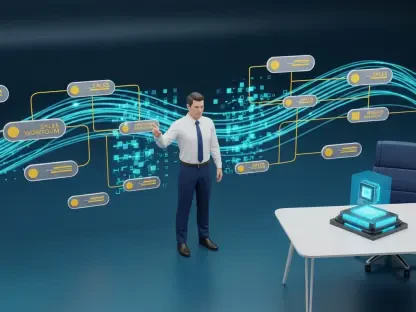

The evolution of artificial intelligence has reached a critical inflection point, transitioning from sophisticated information processors to autonomous economic actors capable of independently executing complex commercial transactions on a global scale. This transformation from passive assistant to active participant heralds the arrival of agentic commerce, an economy where software agents will increasingly manage purchasing decisions on behalf of individuals and businesses. To build the rails for this new frontier, financial technology giant Visa and cloud computing leader Amazon Web Services (AWS) have forged a strategic alliance, aiming to embed secure, machine-initiated payment capabilities directly into the AI development stack, setting a new standard for how transactions are conducted in an automated world.
The Dawn of the Autonomous Economic Agent
The central premise of this new era is the empowerment of AI agents with financial autonomy. These are not merely chatbots that suggest products; they are sophisticated programs designed to understand user intent, research options, negotiate terms, and execute purchases without direct human intervention at every step. This model promises unprecedented efficiency, whether it’s an AI personal assistant booking a multi-leg international trip based on calendar availability and travel preferences or a business system autonomously replenishing inventory when stock levels fall below a predefined threshold. The shift moves the point of transaction initiation from a human user to a software agent, fundamentally altering the dynamics of digital commerce.
However, granting financial agency to a non-human entity introduces a complex set of challenges, primarily centered on security, identity, and trust. The core question becomes how to ensure that these autonomous transactions are legitimate, authorized, and secure from manipulation. The partnership between Visa and AWS directly confronts this issue by creating a foundational infrastructure designed to verify and protect machine-to-machine payments, thereby enabling the broader ecosystem to build and deploy these agents with confidence.
Charting the Trajectory of Agentic Commerce
The move toward agentic commerce is not a speculative future but a logical progression of digital transformation. For years, automation has optimized supply chains and business processes, while AI has personalized consumer experiences. The convergence of these trends, powered by advancements in large language models and generative AI, makes autonomous commercial agents the next inevitable step. Businesses are increasingly seeking to reduce operational friction and unlock new efficiencies, and consumers are growing more comfortable delegating routine tasks to technology. This creates a powerful market pull for solutions that can safely automate commercial activities.
This technological evolution necessitates a corresponding evolution in the financial infrastructure that underpins it. Traditional payment systems were built for human-initiated transactions, relying on manual inputs and human-centric verification methods. In contrast, agentic commerce operates at machine speed and scale, requiring a new framework that can handle high volumes of automated transactions securely and transparently. The collaboration between a global payments network and a leading cloud provider addresses this gap by creating the standardized protocols and tools needed to support this emerging economic model.
The Architectural Blueprint of a New Commerce Infrastructure
At the heart of this alliance is the integration of Visa’s Intelligent Commerce technology into the AWS cloud, made directly accessible to developers via the AWS Marketplace. This move effectively embeds secure payment functionalities deep within the AI stack, allowing developers to seamlessly incorporate machine-initiated payment capabilities into their applications. Visa provides the core components essential for these transactions, including advanced tokenization to protect sensitive data, robust authentication protocols tailored for AI agents, and the ability to create personalized payment flows. This integration ensures that when an AI agent needs to make a purchase, it can leverage Visa’s trusted and secure payment network to execute the transaction safely.
To further accelerate innovation and encourage widespread adoption, the partnership is releasing open-source blueprints within the Amazon Bedrock AgentCore repository. These ready-made templates offer developers standardized workflows for common commercial activities, such as retail shopping, travel booking, and various financial tasks. By providing this foundational code, the initiative lowers the barrier to entry for building commerce-enabled AI agents. It standardizes best practices for security and transaction handling, ensuring that developers can focus on creating innovative user experiences rather than building payment infrastructure from scratch.
Establishing a Digital Trust Layer for an Automated Economy
A primary focus of the initiative is constructing the “trust layer” essential for a secure autonomous economy. In response to the inherent risks of automated transactions, Visa has developed its Trusted Agent Protocol, a verification framework designed specifically to help merchants and financial institutions distinguish between legitimate AI agents and malicious bots. This protocol provides a mechanism to verify a transaction’s AI origin, maintain clear visibility into authorization processes, and mitigate the primary security threats, which include identity abuse, unauthorized purchasing, and sophisticated automated fraud schemes.
The security of this ecosystem is further fortified by the critical role of tokenization. By replacing sensitive card details with a unique digital identifier, or token, the system ensures that the actual payment credentials are never exposed during a transaction. These controlled payment credentials, combined with tokenized data, create a robust shield that protects sensitive information as it moves through the machine-driven ecosystem. This method is not just a security feature but a foundational requirement for building consumer and business confidence in a world where software agents transact on their behalf.
Activating AI Commerce From B2B to Developer Ecosystems
The most immediate and transformative impact of this infrastructure is expected within business-to-business (B2B) operations. For enterprises, the potential for efficiency gains is immense. Autonomous agents can be deployed to handle routine procurement, automatically ordering supplies when inventory runs low based on real-time data. Corporate travel can be streamlined, with AI agents booking flights and accommodations that comply with company policy without manual intervention. Furthermore, financial reconciliation processes can be automated, reducing errors and freeing up human capital for more strategic tasks.
For the developer community, this partnership provides a clear roadmap for building the next generation of agentic applications. By accessing Visa’s technology through AWS, developers can integrate trusted, commerce-enabled capabilities into their AI agents with relative ease. The process involves leveraging the pre-built templates from the AgentCore repository, connecting to Visa’s APIs for payment services, and implementing the Trusted Agent Protocol to ensure security. This accessibility empowers innovators to create a new class of services that can autonomously and securely interact with the global marketplace.
The strategic union of Visa’s payment expertise and AWS’s cloud infrastructure successfully established a vital foundation for the agent-driven economy. By embedding secure payment protocols directly into the AI development environment and providing open-source tools to accelerate innovation, the collaboration addressed the core challenges of trust, security, and interoperability. This initiative did not merely create a new product; it laid the architectural groundwork for a paradigm shift in commerce, paving the way for a future where autonomous agents became trusted and integral participants in global economic activity.