
The sight of a fully automated convenience store operating through the night without a single human employee on the floor represents a significant shift in how the retail industry conceptualizes labor and efficiency. In a recent high-profile technical demonstration titled “Robots Never Clock Out,” the Chinese robotics firm AGIBOT deployed six of its G2 humanoid units into a live-streamed convenience store environment for a continuous twenty-four-hour period. This event, which took place from November 2 to November 3, was designed to push the boundaries of current robotic capabilities by moving beyond the controlled, scripted environments of laboratory settings. By exposing these machines to the chaotic and unpredictable nature of real-world retail, including fluctuating customer traffic, the company sought to validate the stamina and practical utility of its hardware. This trial stands as a testament to the rapid evolution of embodied AI and the drive to integrate complex machinery into everyday spaces.
Operational Versatility in Convenience Environments
Managing Inventory and Customer Service Interactions
Mastering the intricacies of shelf management and inventory organization requires a sophisticated combination of visual processing and physical precision that has long been a hurdle for general-purpose robotics. During the demonstration, the G2 humanoid units were tasked with identifying specific products and placing them accurately within tightly packed display areas, a job that necessitates subtle hand-eye coordination and pressure sensitivity. Beyond simple stocking, the robots managed the complex logistical demands of the morning breakfast preparation phase, where they interacted with kitchen machinery to prepare hot food and coffee. These tasks are particularly challenging because they involve high-temperature equipment and the handling of fragile items, yet the robots displayed a level of manual dexterity that suggests substantial progress in actuator technology. This ability to handle diverse items, from bread to rigid cans, demonstrates the versatility required for a retail shift.
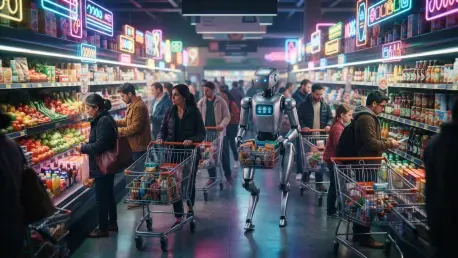
While technical proficiency in item handling is vital, the social dimension of a retail environment presents an entirely different set of obstacles for humanoid machines operating among the public. Throughout the twenty-four-hour challenge, the AGIBOT units were responsible for maintaining store cleanliness by identifying and clearing rubbish, as well as engaging with customers through verbal greetings and basic inquiry responses. Navigating through dense crowds during peak lunch and evening rushes required the robots to maintain spatial awareness and adjust their walking paths in real-time to avoid collisions. These interactions served as a critical stress test for the robots’ social navigation algorithms, forcing them to prioritize safety while continuing to execute their assigned cleaning and service duties. The successful management of these interactions indicates that humanoid hardware is nearing a point where it can coexist with humans in confined spaces without disruption.
Assessing the Path toward Full Autonomy
The transition from theoretical capability to genuine operational autonomy remains the most significant frontier for the current generation of humanoid robots being tested in professional settings. Unlike the polished and edited promotional clips often released by tech companies, the live-streamed format of the AGIBOT challenge provided a transparent view of how these machines handle errors and physical setbacks. Observers were able to witness the nuances of robotic labor, such as the machines’ ability to recover from failed grasping attempts or their capacity to reroute when a designated path was suddenly obstructed by a shopping cart. This level of transparency is essential for building trust among retail stakeholders who require consistent performance over several hours rather than a few minutes. By utilizing new AI models and a productivity metric known as Worken, the developers aimed to quantify how efficiently these robots could perform tasks relative to human employees.
The trial demonstrated that while the hardware reached impressive milestones in mobility and task completion, the path toward fully autonomous and uninterrupted commercial operation still required more work. Industry experts noted that the success of such demonstrations depended heavily on the frequency of human intervention and the consistency of power supply throughout the shift. Stakeholders determined that the implementation of standardized scoring systems would be the next logical step to accurately measure failure rates and the practical return on investment for automated labor. Businesses began to consider how to redesign store layouts to better accommodate robotic movements while maintaining a welcoming atmosphere for human shoppers. Ultimately, the event provided a realistic framework for the service industry, suggesting that the integration of humanoid staff would depend on refined software recovery protocols and battery solutions that improved over time.