
The rapid metamorphosis of the Chinese consumer market has moved far beyond the traditional exchange of currency for physical goods, evolving into a sophisticated digital ecosystem where algorithms act as both concierge and curator. As domestic demand accounts for a staggering 52 percent of national economic growth, the industry has undergone a fundamental structural pivot. This transformation is no longer about the volume of transactions but rather the qualitative intelligence behind every interaction. By integrating advanced machine learning into the very bedrock of retail, the sector has established a new global standard for how technology interacts with human desire.
The Dawn of AI-Centric Retail Infrastructure
The current retail landscape relies on a complex neural network of data processing that has moved from basic automation to true autonomous decision-making. Unlike previous iterations of e-commerce that functioned as digital filing cabinets for inventory, this new infrastructure predicts consumer needs before they are explicitly stated. It functions as a living framework, blending logistics, marketing, and customer service into a single, unified stream of data that adapts in real time to market fluctuations and individual behaviors.
This transition marks a departure from traditional efficiency tools that merely sped up human tasks. Today, the infrastructure operates independently, managing supply chain adjustments and pricing strategies without manual intervention. This shift toward autonomy is what differentiates the current Chinese model from its global competitors. While others focus on the storefront, this system prioritizes the underlying logic, ensuring that the entire lifecycle of a product is optimized for the specific context of the user.
Core Pillars of the AI-Driven Retail Ecosystem
AI Agent Integration in the Consumer Journey
Artificial intelligence agents have become the invisible architects of the modern shopping experience, guiding users from the initial spark of curiosity to the final click of a purchase. These agents do more than suggest products; they negotiate the complexities of the consumer journey by filtering through noise to present only the most relevant options. This deep integration has successfully reduced merchant workloads by 30 percent, allowing businesses to focus on creative strategy rather than repetitive administrative tasks.
The performance of these agents is measured not just in speed, but in the precision of their conversion. By understanding the nuance of intent, these systems have significantly boosted click-through rates. This is achieved through a deep understanding of psychological triggers and timing, ensuring that the interaction feels like a personalized consultation rather than a generic advertisement. The result is a seamless flow where the friction of decision-making is almost entirely removed.
Intelligent Information Synthesis and Retrieval
Traditional search methods are rapidly becoming obsolete as 65 percent of consumers now opt for synthesized AI overviews over long lists of search results. These systems do not just find information; they interpret it, providing concise summaries that highlight quality, price comparisons, and user sentiment in a single glance. This shift toward synthesis addresses the problem of information overload, delivering high-quality product insights at a speed that traditional search engines simply cannot match.
The technical sophistication of these retrieval systems allows for a multi-layered understanding of product specifications and real-world performance. By aggregating thousands of reviews and technical data points into a coherent summary, the AI provides a level of transparency that was previously impossible. This reliability has built a new foundation of trust between the platform and the user, as the information provided is perceived to be more objective and comprehensive than standard marketing copy.
Emerging Trends: From Goods Consumption to Emotional Services
The market is currently witnessing a profound shift from the acquisition of physical objects toward the pursuit of personalized experiences and emotional fulfillment. This diversification of the services sector reflects a maturing economy where consumers prioritize health, education, and leisure over simple material accumulation. Government guidelines have accelerated this trend, encouraging growth in specialized fields like eldercare and inbound tourism, which require a much higher degree of human-centric sensitivity than traditional retail.
Innovation in this space is driven by the need to provide services that feel bespoke and empathetic. AI is being utilized to manage the logistical side of these services—such as scheduling or health monitoring—while freeing human providers to focus on the emotional and social aspects of care. This hybrid model ensures that as the population ages and lifestyles become more complex, the retail environment can pivot to meet these new, more intimate demands with the same efficiency once reserved for electronics or apparel.
Real-World Applications and Market Implementation
The practical application of these technologies has propelled China’s AI-driven e-commerce market toward a projected value exceeding 800 billion yuan this year. This growth is not evenly distributed but is concentrated in sectors that leverage hyper-personalization. For instance, recommendation segments that utilize deep-learning algorithms are seeing annual growth rates of over 30 percent, demonstrating that consumers are willing to spend more when they feel the platform truly understands their unique preferences and lifestyle constraints.
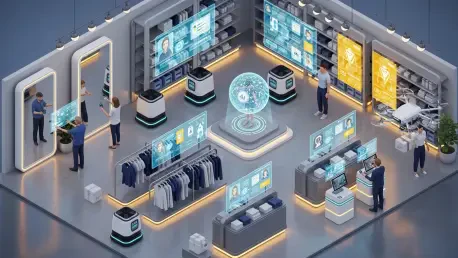
Implementation is visible in high-traffic urban centers where digital and physical retail have blurred into a single experience. Automated kiosks and smart mirrors utilize the same AI backends as mobile apps, providing a consistent omnichannel experience. These real-world deployments prove that the technology is robust enough to handle the scale of a massive population while maintaining the precision required for individual satisfaction, setting a benchmark for international trade partners.
Strategic Hurdles and Implementation Barriers
Despite the rapid progress, the industry faces significant technical hurdles, particularly in achieving “true” personalization that goes beyond simple pattern recognition. Current systems are excellent at predicting what a user might want based on past behavior, but they still struggle with the unpredictability of human emotion and changing life stages. Furthermore, the market must navigate the complexities of a rapidly aging demographic, requiring interfaces and services that are accessible to those who may not be as digitally native as the younger generation.
Regulatory alignment remains another critical barrier, as the push for data-driven retail must be balanced against privacy concerns and the need for structural optimization. Ongoing development efforts are focused on creating “privacy-first” AI models that can deliver high levels of personalization without compromising sensitive user data. Overcoming these limitations requires a delicate balance of technical innovation and ethical oversight to ensure the system remains sustainable in the long term.
Future Outlook: The Next Wave of Economic Expansion
The trajectory of the retail sector is pointing toward a human-centric service model that utilizes digital tools as a supportive background rather than a front-facing distraction. The next phase of expansion will likely see breakthroughs in AI-driven marketing that can anticipate macro-economic shifts, allowing brands to adjust their offerings before a trend even hits the mainstream. This proactive approach will redefine global retail standards, moving away from reactive selling toward a more predictive and harmonious relationship with the consumer.
Potential developments in generative media and interactive interfaces will further bridge the gap between the digital and physical worlds. As these tools become more sophisticated, the distinction between “online” and “offline” shopping will disappear entirely. This evolution will focus on enhancing the quality of life, using AI to manage the mundane aspects of consumption so that individuals can spend more time engaging with the experiences and services that provide genuine value and fulfillment.
Final Assessment of the AI-Powered Retail Evolution
The evolution of AI-powered retail represented a decisive shift from a volume-based economy to one defined by qualitative precision. This transformation successfully integrated autonomous decision-making into the consumer journey, proving that technology can enhance human experiences rather than merely replacing them. By prioritizing personalized services and emotional fulfillment over mass production, the industry established a resilient framework capable of adapting to complex demographic shifts. The transition toward a service-oriented model demonstrated that the future of international trade lies in the intelligent synthesis of data and human-centric design. Ultimately, the strategic optimization of these digital tools ensured that the retail sector remained the primary engine of economic progress, offering a sophisticated blueprint for the global market.