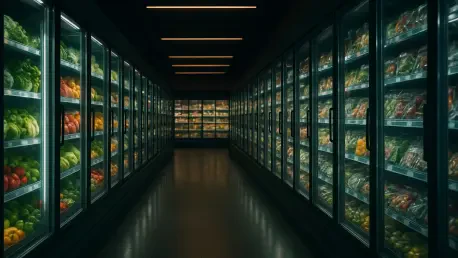

The hum of a supermarket refrigeration rack serves as the heartbeat of global food security, yet this vital infrastructure currently faces an existential crisis driven by chemical phasedowns and rising energy costs. This fundamental component of the food supply chain is no longer just a background utility; it is the primary determinant of retail profitability and environmental impact. As grocers balance the necessity of keeping products at precise temperatures with the escalating demand for sustainable operations, the technical complexity of cooling systems has skyrocketed. The industry is currently in a state of high-stakes evolution, where every decision regarding hardware and refrigerants has long-term financial consequences.
Traditional cooling methods are being dismantled in favor of integrated smart systems that prioritize both safety and efficiency. This shift is not merely voluntary but is driven by a global movement toward environmental stewardship that has fundamentally altered the scope of modern supermarket operations. Market players who once relied on standardized, high-impact chemical units are now forced to navigate a fragmented landscape of natural alternatives and digital controls. Consequently, the ability to manage these sophisticated systems has become a key competitive advantage in an increasingly thin-margin business.
Market leaders are progressively moving away from traditional hydrofluorocarbon (HFC) units toward decentralized systems that offer better redundancy. This technological transition is complicated by the need to maintain constant food safety standards while reducing the massive carbon footprint associated with legacy cooling. Moreover, the integration of smart sensors and automated monitoring is changing the role of store managers from simple observers to data analysts. This evolution signifies a broader trend where the physical cooling of goods is inextricably linked to the digital health of the entire enterprise.
The scope of modern supermarket operations has expanded to include aggressive sustainability goals that were once considered peripheral to the core business. Global movements targeting carbon neutrality have forced retailers to view their refrigeration assets as liabilities if they do not meet stringent efficiency benchmarks. In this environment, the environmental impact of a leak or an inefficient compressor is measured not just in repair costs but in brand reputation and regulatory standing. As a result, the industry is seeing a convergence of corporate social responsibility and operational pragmatism.
Identifying Key Trends and Market Projections in Cold Chain Innovation
Emerging Technologies and the Shift Toward Natural Solutions
The industry is witnessing a significant resurgence in natural refrigerants, with carbon dioxide (R-744), propane (R-290), and ammonia reclaiming their place in the retail environment. These substances offer ultra-low global warming potential, making them the preferred choice for retailers looking to escape the cycle of synthetic chemical phasedowns. However, the higher pressures required for CO2 systems and the flammability of propane require entirely different engineering approaches and safety protocols. Despite these complexities, the move toward natural solutions is gaining momentum as the long-term regulatory path becomes clearer.
Beyond the refrigerants themselves, the integration of the Internet of Things (IoT) and predictive maintenance is revolutionizing energy optimization. Smart building controls now allow retailers to monitor the performance of individual display cases in real time, identifying potential failures before they result in product loss. These systems use machine learning to adjust cooling cycles based on ambient store humidity and peak energy pricing. This transition from reactive to proactive maintenance is essential for minimizing the downtime that can devastate a store’s bottom line.
The explosion of online grocery fulfillment and the rise of micro-fulfillment centers are also reshaping refrigeration design. Modern stores are no longer just showrooms; they are hybrid distribution hubs that require diverse cooling zones for curbside pickup and rapid home delivery. This requires modular refrigeration units that can be easily reconfigured or expanded as consumer shopping habits evolve. The design of the store floor is becoming more fluid, with cooling technology following the flow of the digital customer journey.
Consumer demand for green brands is further accelerating the adoption of sustainable cooling strategies. Modern shoppers are increasingly aware of the environmental cost of their food, and a retailer’s commitment to low-emission refrigeration can be a powerful marketing tool. Corporate cooling strategies are now often highlighted in annual transparency reports, serving as proof of a brand’s dedication to the planet. This consumer pressure ensures that the transition to green technology is a permanent shift rather than a passing trend.
Quantifying Growth and the Economic Outlook for Retail Cooling
Transitioning from legacy equipment to modern standards involves significant capital expenditure, with retrofit costs for existing stores reaching unprecedented levels. Retailers must decide whether to patch existing HFC-based systems or invest in full-store natural refrigerant conversions. Data suggests that while the initial investment for a CO2 rack system can be significantly higher than traditional hardware, the long-term energy savings often justify the cost. However, the financial burden remains a significant hurdle for independent grocers who may not have the same access to capital as national chains.
Performance indicators show a direct correlation between modern refrigeration efficiency and overall bottom-line margins. In a typical supermarket, refrigeration accounts for nearly half of the total energy consumption, meaning even a five percent increase in efficiency can result in substantial annual savings. Grocers who prioritize high-efficiency equipment are finding themselves more resilient to the fluctuations in the energy market. Consequently, the economic outlook for retail cooling is increasingly defined by the ability to manage operational costs through technological superiority.
The market for refrigerants is currently facing extreme volatility as global production quotas for HFCs continue to tighten through 2029. This supply-side pressure is expected to drive the price of common synthetic gases upward, making the maintenance of older systems prohibitively expensive. Retailers who are slow to transition may find themselves trapped in a cycle of rising service costs and dwindling chemical availability. This economic reality is serving as a powerful catalyst for the early adoption of natural or ultra-low global warming potential alternatives.
Long-term ROI projections are increasingly favoring high-efficiency modular equipment over traditional large-scale rack systems. Modular units allow for targeted upgrades and smaller refrigerant charges, which reduces the financial risk associated with large-scale leaks. These systems also offer greater flexibility for store remodels, as they can be moved or scaled without requiring a total overhaul of the central machine room. This shift in investment strategy reflects a broader move toward agility and risk mitigation in the face of an uncertain economic and regulatory future.
Overcoming the Infrastructure Bottleneck and Operational Obstacles
Addressing the legacy gap remains one of the most daunting challenges for established retailers, as many facilities utilize antiquated piping and machine rooms. Upgrading these systems often requires extensive demolition and long periods of store downtime, which can alienate customers and hurt sales. Strategies are being developed to implement phased upgrades, where portions of the store are converted to newer technology while the rest continues to operate on legacy systems. However, this hybrid approach creates its own set of technical challenges regarding system pressure and compatibility.
Managing the complexity of multi-manufacturer systems and proprietary control platforms is another significant operational hurdle. Many supermarkets are a patchwork of different brands and generations of equipment, making it difficult to achieve a unified view of store performance. The lack of standardized communication protocols often leads to “data silos,” where different systems cannot share information to optimize overall energy use. Overcoming this requires a commitment to open-source or interoperable controls that can bridge the gap between disparate hardware components.
The industry is also facing a critical workforce crisis, characterized by a widening skill gap among technicians. There is a desperate need for professionals who can service both fifty-year-old mechanical valves and cutting-edge digital controllers. As the workforce ages, younger technicians are often lured away by other high-tech sectors, leaving the refrigeration industry with a shortage of qualified labor. Bridging this gap will require substantial investment in specialized training programs and a rebranding of the trade to emphasize its high-tech future.
High-priority leak management is essential for both financial stability and environmental compliance, especially given the industry-average leak rate of 25 percent. Losing a quarter of the refrigerant charge every year is an unsustainable practice that leads to higher energy bills and increased regulatory scrutiny. Retailers are now implementing aggressive leak-detection strategies, using ultrasonic sensors and automated gas monitoring to identify small breaches before they become major events. Reducing these rates is not just about environmental responsibility; it is a critical component of cost containment in a high-price refrigerant market.
Mastering the Regulatory Landscape and Compliance Mandates
Navigating the EPA Technology Transitions rule and the mandatory HFC phasedown schedule is a primary focus for compliance officers this year. The current step-downs in chemical production are designed to force the market toward lower global warming potential (GWP) alternatives. Retailers must carefully time their equipment replacements to avoid being stranded with unserviceable assets. This regulatory pressure is uniform across the country, but the specific local requirements for implementation can vary, adding another layer of complexity to national rollouts.
Increasing scrutiny over PFAS, or “forever chemicals,” is also casting a shadow over the future of some synthetic HFO refrigerants. While these chemicals were originally marketed as the solution to HFC phasedowns, concerns about their environmental persistence are leading to new rounds of potential restrictions. This uncertainty makes natural refrigerants like CO2 and propane even more attractive, as they are largely exempt from such chemical-specific scrutiny. Retailers must remain vigilant as the definition of acceptable refrigerants continues to evolve in response to new scientific data.
The role of mandatory automatic leak detection (ALD) systems is becoming more prominent as regulatory bodies demand better recordkeeping and accountability. These systems provide a digital paper trail that can be used to prove compliance during inspections. Rigorous recordkeeping is no longer an option but a central requirement for legal operation, with significant fines for those who fail to maintain accurate logs. This shift is pushing the industry toward a more disciplined and data-driven approach to maintenance and gas tracking.
Local and international energy codes are also exerting influence on new construction and major renovations. These codes often mandate minimum efficiency standards that go beyond what is required for basic food safety. In many jurisdictions, getting a building permit for a new supermarket now requires a detailed energy model that includes the refrigeration system. This means that the design phase of a new store is more collaborative than ever, involving architects, engineers, and refrigeration specialists from the very beginning.
Forecasting the Future: Toward a Decarbonized and Digitized Retail Model
The industry is moving toward a model known as Refrigeration as a Service (RaaS), where grocers outsource the management and ownership of their cooling systems to third-party specialists. This allows retailers to pay a monthly fee for “cold” rather than managing the complex maintenance and regulatory burdens themselves. RaaS can help bridge the capital expenditure gap for smaller grocers, as the service provider typically handles the installation of modern, high-efficiency equipment. This model is gaining traction as retailers look to simplify their operations and focus on their core business of selling food.
Potential market disruptors like AI-driven energy arbitrage and grid-interactive refrigeration are on the horizon. These systems allow supermarkets to act as “thermal batteries,” storing cooling capacity when energy is cheap and reducing their load during peak demand periods. This grid-interactive approach can generate revenue for the retailer by providing stability to the local power grid. As energy markets become more volatile, the ability to turn a store’s refrigeration system into a flexible energy asset will become increasingly valuable.
The transition from mere data acquisition to actionable intelligence is the next frontier in store operations. Having thousands of data points is useless if the system cannot automatically suggest a course of action to the store manager. Future systems will use artificial intelligence to diagnose complex issues and schedule repairs automatically, without human intervention. This level of automation will be necessary to compensate for the technician shortage and to ensure that stores operate at peak efficiency at all times.
Independent grocers are finding creative ways to compete with large chains in the race to future-proof their infrastructure. By forming purchasing cooperatives and sharing best practices for modular retrofits, smaller operators are managing to navigate the transition without the massive budgets of their larger rivals. The success of these independents will depend on their ability to remain agile and adopt new technologies faster than the bureaucratic giants. In the end, the race to modernize refrigeration will be won by those who can best integrate sustainability into their long-term financial planning.
Strategic Synthesis: Building Resiliency in Supermarket Refrigeration
The transition toward modernized cooling platforms demonstrated that operational survival depended on more than just swapping gases. Successful enterprises moved beyond reactive repairs to adopt a holistic lifecycle approach that accounted for energy fluctuations and regulatory shifts. By investing in modular systems and comprehensive employee training, these retailers transformed a traditional liability into a streamlined asset. The shift solidified the understanding that early investment in low-impact technology was the only viable path to long-term profitability.
Grocers who prioritized leak containment and rigorous monitoring protocols achieved significant cost reductions that stabilized their bottom lines during periods of chemical scarcity. These organizations recognized that workforce development was as critical as hardware upgrades, ensuring their technicians were prepared for the digital complexities of the current era. The adoption of smart, grid-interactive systems also provided a new revenue stream, proving that environmental responsibility and financial performance were not mutually exclusive goals.
The move toward decarbonization became a cornerstone of commercial viability, separating market leaders from those struggling with obsolete infrastructure. Strategic planning focused on long-term ROI rather than immediate savings, allowing retailers to navigate the volatility of the mid-2020s with confidence. By embracing the digitized retail model, the industry successfully turned a series of technical challenges into a roadmap for a more resilient and sustainable food supply chain. Overall, the proactive measures taken during this period established a foundation for continued growth in an increasingly regulated global market.