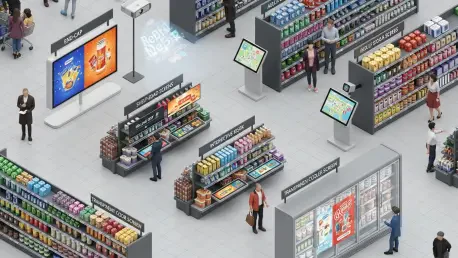

Screens do not equal impressions. Without observed shopper presence, dwell time, and movement, in-store retail media pricing turns into guesswork. Brands sense the gap. Retailers feel it in stalled pilots, makegoods, and slow renewals. The fix is not more screens or a flashier content loop. The fix is a measurement that reflects how people actually move and pay attention inside a store.
Retail media now has a permanent budget line, and in-store is the next frontier. In the United States, retail media ad spend reached almost $55 billion in 2024, according to eMarketer’s H1 2024 forecast, with in-store one of the fastest-growing slices of that mix. As spending shifts into physical environments, digital standards are following. IAB and IAB Europe published their final In-Store Retail Media: Definitions and Measurement Standards in December 2024. The document establishes Opportunity To See (OTS) as the primary impression metric for in-store media. It also sets expectations for exposure and attention inputs across onsite, offsite, and in-store channels. The bar for proof just got higher.
Why Many In-Store Programs Underperform
Most underperforming networks share a pattern. They rely on screen counts, playouts, or assumed reach models. They smooth traffic into storewide averages. They cannot separate pass-through traffic from true engagement zones. That approach can launch a pilot. It cannot sustain a scaled program that must defend media pricing quarter after quarter.
Counting screens is not counting people: a powered-on display is not evidence of exposure. Store averages hide volatility because traffic and dwell shift by daypart, promotion, and weather, and averaging them masks what buyers actually paid for. Movement is the missing layer — without direction and speed, a shopper walking past a screen looks identical to a shopper waiting within its field of view.
The result is predictable. Brands increase scrutiny. Retailers fall back on makegoods and discounts. The conversation becomes defensive instead of data-driven.
The Right Unit of Value: Observed Opportunity To See
Impressions are earned, not assumed. The right unit of value is observed OTS, not theoretical potential.
Footfall establishes presence and answers whether people were in the zone where a screen could be seen. Dwell time shows opportunity and answers whether shoppers remained long enough to notice and process the message. Movement validates quality and distinguishes passersby from browsers, queues, and other intent-rich states.
These inputs are the foundation for credible reach and frequency. When teams can point to changes in daypart dwell around a display or to line-length fluctuations at a service counter, the narrative shifts from defense to diagnosis.
Measure the Store at the Zone Level, Not the Store Average
Stores are not uniform. They are a mosaic of zones with very different attention profiles. A high-velocity aisle, a fresh department with natural dwell, and a checkout queue have nothing in common from a media standpoint. Pricing them as equals destroys value.
A zone is a physical area with shared behavior patterns and a clear relationship to a specific screen or placement. For each zone, teams should track unique visitors within a reporting window; average dwell time within the screen’s effective field of view; movement signatures that indicate intent states, such as slow browse or queue wait; and volatility measures that capture daypart swings and promotional effects.
With those inputs, media owners can price inventory based on demonstrated OTS. They can explain why Zone A commands a premium and why Zone B should be sold as value inventory or redesigned. When a placement underdelivers, they can point to a causal driver the brand can recognize, such as an operational change that shortened queue times.
Pass-Through vs. Intentional Exposure
Not all footfall is equal. A corridor that moves shoppers between departments generates volume but limited attention. A service counter, digital kiosk, or sampling area generates slower movement and longer dwell. Treating these states as identical distorts both reporting and strategy.
A practical model classifies exposure quality into three buckets. Brief pass-through is directional movement above a speed threshold with low exposure likelihood. Incidental linger is movement below a threshold but without a clear stopping point, with moderate exposure likelihood. Intentional dwell is movement pausing within a defined field of view, or a queue forming, with high exposure likelihood.
This classification does not need face detection or identity. It needs reliable presence, dwell, and movement signals mapped to clear zones. Research on advertising attention is consistent on this point: dwell time is a strong predictor of ad recall, not screen-on time. Dentsu’s multi-market attention studies found that increasing dwell time from two seconds to fourteen seconds nearly doubles prompted recall. Consequently, the same ad delivers twice the impact when exposure is longer and more intentional.
Why Cameras Create More Risk Than Proof
As scrutiny rises, some networks turn to camera-based analytics or biometric shortcuts. The trade-offs are material.
Regulatory exposure is increasing. The EU AI Act, which entered into force in August 2024 and began enforcing initial obligations in February 2025, treats real-time biometric identification in publicly accessible spaces as a prohibited or heavily restricted application, with most provisions fully applicable from August 2026. In the US, the California Privacy Rights Act treats biometric identifiers as sensitive personal data subject to enhanced notice and deletion obligations. It is a compliance framework that state-level enforcement has been actively applying since 2024.
Consumer tolerance is limited. A Brookings Institution survey found that half of US internet users were unfavorable toward the use of facial recognition software in retail stores, even when the stated purpose was theft prevention. Shoppers tolerate cameras framed as security measures but are more resistant to perceived behavioral profiling, especially when the data feeds an advertising system.
Operational friction is real. Camera deployments often trigger legal reviews, union concerns, and public relations risks that slow or stop rollouts. The IAB’s own in-store measurement framework explicitly states that presence measurement does not require facial recognition or biometric identification, positioning privacy-safe sensing as both a technical and strategic advantage.
Cameras can answer questions about creative performance that are not necessary to sell media. For scaled programs, the path of least resistance is non-intrusive, sensor-based analytics that deliver presence, dwell, and movement without collecting biometric identifiers.
A Practical Measurement Architecture
Measurement cannot be a bolt-on. It is the core system that underwrites inventory, pricing, and reporting. A pragmatic architecture includes:
Zoning blueprint. A store map with defined zones tied to specific placements, each with clear boundaries and data capture coverage.
Sensor mix tuned to the environment. Options include privacy-safe radios, ceiling sensors, and calibrated mobile presence signals. The goal is stable detection of presence and dwell, not identity.
Data model aligned to media. Store unique presence counts, dwell distributions, and movement vectors at the zone level, mapped to one or more screens with a defined field of view.
OTS calculation rules. Document how OTS is derived from presence and dwell. Align with the IAB’s December 2024 In-Store Retail Media Definitions and Measurement Standards, which provides calculation guidance specifically designed to speed brand approvals and create audit trails from inputs to reported numbers.
QA and calibration loop. Periodically test detection stability, recalibrate zones after store resets, and validate that movement signatures match observed behavior.
This architecture creates traceability. When a brand questions a result, the team can show the inputs, the calculation, and the environmental factors that shaped the outcome.
Implementation Realities and Constraints
Two issues frequently stall programs, even when the measurement design is sound.
Store change is constant. Resets, seasonal displays, and operational shifts move fixtures and alter traffic patterns. Zoning and sensor placement need a maintenance plan, not a one-time build.
Governance takes time. Privacy reviews, data processing agreements, and retailer security checks are non-negotiable. Teams that engage early with clear data minimization principles can clear approvals faster.
These are manageable constraints when planned up front. They become existential risks when treated as afterthoughts.
How to Report Like a Media Company
Reporting should help a brand answer three questions quickly: what reach and OTS did the buy deliver in each zone and daypart; what drove the variance versus plan, positive or negative; and what optimization will be applied on the next flight based on observed behavior.
The best reports teach the buyer how the store works. When a dashboard shows dwell rising in the fresh department during a promotion and lifting OTS for a nearby screen, the connection is obvious. When it shows a queue solution cutting wait times and reducing OTS at checkout, the learning is actionable. Reporting becomes a value-add, not a receipt.
When Measurement Replaces Assumption, Pilots Scale
Pilots often fail quietly. Budgets do not expand, and additional stores do not get funded because buyers need proof, not potential. Programs built on zone-level presence, dwell, and movement give media, operations, and analytics teams a common operating picture. They can explain what happened, why it happened, and what changes on the next flight, while protecting shopper trust through non-intrusive sensing.
Conclusion
The unit of value in-store is not the screen. It is observed OTS inside a defined zone. That distinction is not semantic. It determines whether rate cards hold under scrutiny, whether makegoods become routine, and whether pilots convert to scaled budgets.
The trade-off is direct: monetize quickly on assumed reach and absorb the audit risk, or build a measurement spine that can withstand brand and legal review before scaling. The first path moves faster initially. The second path is the only one that supports durable revenue.
Regulatory pressure on biometric and location data is moving in one direction. Retailers that standardize on privacy-safe presence and dwell measurement reduce approval friction and carry less legal exposure than those relying on camera-based inference. The competitive advantage in in-store retail media will not come from screen count. It will come from the ability to prove zone-level attention, consistently and at scale, in an environment where that proof is increasingly the baseline expectation, not a differentiator.