
The Hook: The $4.4 Trillion Blind Spot
Shoppers filled carts, tapped cards, and walked out with brand favorites while brands stayed blind to the very transactions that proved devotion across grocery aisles, beauty counters, and corner stores nationwide.By 2030, U.S. ecommerce is projected to reach $1.8 trillion—about 29% of retail—leaving roughly $4.4 trillion in store purchases that largely vanish from brand databases. The dilemma is stark: if loyalty happens off-channel, how can brands recognize and reward it without owning the point of sale?
A loyal customer may buy the same serum at Ulta every month or a favored snack at a neighborhood market every week, yet never appear in a brand’s CRM. This gap distorts lifetime value, limits retention triggers, and dulls the impact of promotions. A practical fix now gaining momentum reframes the problem: let shoppers upload receipts for rewards, no matter where they bought, and turn physical proof of purchase into first-party data.
Why This Story Matters
The way people shop no longer fits the way many loyalty programs work. Despite omnichannel habits, loyalty mechanics often remain tied to owned digital checkout, concentrating rewards where a minority of transactions occur. That mismatch suppresses returns on loyalty investments and leaves high-intent customers unacknowledged.
Gaps in purchase visibility carry real costs. When third-party and in-store sales are invisible, brands misread LTV, under-identify high-value segments, and miss windows to prompt repeat behavior. Moreover, consumer expectations have moved on: 74% say loyalty should work the same online and offline, and inconsistency erodes perceived value. Indirect distribution compounds the issue for CPG, beverage, and beauty, where retailer data is limited, delayed, or paywalled.
Receipt uploads resolve these tensions without requiring POS control. By accepting a photo or scan, brands capture SKU-level detail, store, time, and basket context as consented first-party data. The method turns anonymous buyers into addressable profiles and creates an immediate, rewarding post-purchase moment that can deepen engagement when validation is fast and guidelines are clear.
Turning Receipts Into Relationships
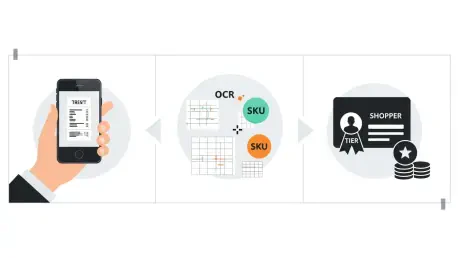
At its simplest, a receipt-upload program invites customers to scan or upload a purchase receipt to earn points, perks, or tier credit—regardless of purchase location. Optical character recognition and barcode parsing read line items and totals, while SKU dictionaries match eligible products and promotions. Rules link the validated purchase to a customer profile, and rewards appear quickly to reinforce the behavior.
For brands, the benefits span identification and influence. Programs extend recognition beyond owned sites to in-store and marketplace buyers, unlocking lifecycle messaging to audiences that were previously unreachable. Universal earning nudges trial, trade-up, and multipack purchases inside retailers’ four walls, where most category growth still happens. Over time, a richer view of LTV emerges, grounded in the full pattern of real-world purchasing.
Shoppers gain parity and clarity. Recognition attaches to brand preference, not checkout counter, with progress tracking that travels between channels. The act of uploading creates a meaningful post-purchase touchpoint; when approval hits within seconds and rewards are explicit, the exchange feels fair and satisfying rather than transactional.
Receipt-level data is the dividend. Basket context reveals co-purchases, trip type, and price sensitivity, informing next-best-action models. Store-level insights support geo-targeted offers and inventory coordination, particularly helpful for event-driven beverage pushes or seasonal beauty sets. As one data scientist put it, “Receipt precision closes the attribution loop and stabilizes LTV estimates that used to wobble on partial data.”
The field evidence has grown. A CPG pilot offering “earn on any grocer’s receipt” plus a repeat-bonus within 30 days doubled identifiable buyers in wholesale-heavy regions. A beauty brand let Ulta and Sephora receipts unlock tier progress and samples, lifting retention without broad discounting. During a city festival, a beverage label ran geo-limited “buy in-store, earn online” promotions, translating foot traffic into segments for later launches.
Execution matters. Effective programs follow a simple framework: capture, verify, reward, learn. Prompts ride emails, QR codes on packaging, SMS, and apps; OCR plus SKU normalization manage accuracy; rewards post immediately with transparent rules; and insights feed CDPs to refine segments, suppress duplicates, and power retail media targeting. Fraud controls—duplicate detection, doctored-image checks, and date validation—protect integrity; privacy principles—clear consent, minimal collection, and retention limits—safeguard trust.
Expert Voices and Research Signals
Industry projections reinforce the urgency: even as ecommerce scales to $1.8 trillion by 2030, most retail spend remains in stores. Consumer research shows 74% expect loyalty parity across channels, a standard many brands have yet to meet. These two truths frame the opportunity for rethinking how loyalty data is gathered.
“Channel-bound programs underperform wherever the brand doesn’t own the checkout,” noted a loyalty strategist who advises multi-retailer portfolios. “Receipt uploads move recognition to where choice actually happens.” A program manager added, “Upload-to-reward in under 60 seconds lifted repeat rate without extra discounting—speed and clarity did more than coupons.”
A data leader summed up the modeling impact: “When receipt data fills indirect sales gaps, churn risk calms down and next-best-action gets sharper. You stop over-rewarding the loudest channel and start rewarding the most loyal customer.”
From Proof of Purchase to Proof of Loyalty
The path forward favored practical steps over grand overhauls. Teams started narrow—defined product sets, simple earning rules, and a handful of priority retailers—then expanded SKU coverage and incentives by region. Integration with CRM and CDP unified profiles, while store mapping and SKU normalization stabilized parsing at scale.
Measurement guided iteration. Programs tracked identifiable-buyer rate, upload-to-approval time, and cost per verified purchase, then modeled incremental repeat and share gains in treated geos. Packaging and shelf callouts helped bridge the aisle-to-app gap, and co-branded pushes with retailers amplified uptake without requiring POS integration.
Receipt uploads had translated invisible loyalty into measurable action. Brands recognized customers wherever they shopped, shoppers felt seen without friction, and data finally reflected how people really buy. The result pointed to a sturdier loyalty engine—one built on proof of purchase, not place of purchase.