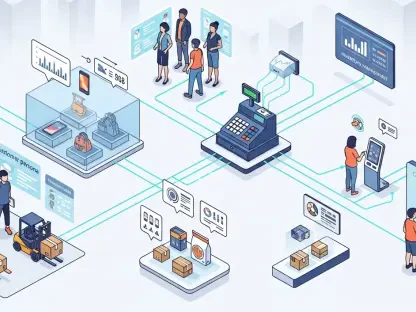

Beyond the Shopping Cart: Shopify’s New Growth Engines
Shopify has long been synonymous with empowering entrepreneurs and direct-to-consumer brands, but its latest financial performance reveals a company undergoing a powerful transformation. With fourth-quarter revenue surging 31% to $3.67 billion and full-year revenue climbing 30% to $11.56 billion for fiscal 2025, it is clear that new forces are at play. This remarkable growth is not just a continuation of its past success; it is the result of a deliberate and strategic pivot toward two of the most significant frontiers in digital commerce: the high-value business-to-business (B2B) market and the revolutionary potential of artificial intelligence. This article will explore how these twin engines are propelling Shopify’s expansion, reshaping its identity, and setting the stage for its next chapter.
From DTC Darling to E-commerce Behemoth
To appreciate the significance of Shopify’s current strategy, it is crucial to understand its origins. The company built its empire by democratizing e-commerce, providing small and medium-sized businesses with the tools to compete against retail giants. Its user-friendly platform became the backbone of the direct-to-consumer (DTC) movement, fostering a new generation of online brands. However, the digital commerce landscape has evolved. The lines between wholesale and retail are blurring, and merchants increasingly demand a unified system to manage all their sales channels. Simultaneously, the explosion of generative AI has created an entirely new, conversational interface for shopping, posing both a threat and a massive opportunity. Shopify’s push into B2B and AI is a direct response to these industry shifts, representing a natural evolution from its foundational mission to arming merchants for the future of commerce, whatever form it takes.
The Dual Pillars of Shopify’s Modern Expansion
The B2B Gold Rush: Tapping into the Wholesale Market
One of the most dramatic stories in Shopify’s recent success is its aggressive and highly effective move into the B2B sector. While still a smaller part of its total business, B2B Gross Merchandise Volume (GMV) skyrocketed by an astonishing 96% in 2025. This explosive growth is directly tied to the sophisticated B2B-centric features integrated into its Shopify Plus plan. The platform now empowers merchants to manage wholesale operations with the same ease as their consumer-facing stores by offering tools for custom company accounts, negotiated pricing, unique product catalogs, flexible payment terms, and automated volume discounts. This unified approach eliminates the need for separate, often clunky systems, a major pain point for businesses serving both retail customers and wholesale clients. The addition of major distributors like Sonepar underscores the success of this strategy, proving Shopify can scale its solutions to meet the complex demands of large-scale enterprise clients.
Pioneering Agentic Commerce: The AI-Powered Future of Shopping
Beyond expanding its customer base, Shopify is fundamentally reimagining the customer journey through its deep investment in AI, or what it calls “agentic” commerce. The company’s strategy is to position its merchants at the center of a world where purchases originate not on a website, but within AI-powered conversations in tools like Google Gemini and ChatGPT. Through the co-developed Universal Commerce Protocol, Shopify is building the essential plumbing that allows these AI agents to connect directly to a merchant’s storefront. This enables a seamless experience where a consumer can discover and select a product within a chat interface, with Shopify securely and reliably handling the final checkout, payment, and fulfillment. Critically, this model ensures merchants retain full control over their pricing, inventory, and order management, preventing them from being disintermediated by new technology.
Profitability and the Bigger Picture: Balancing Growth with Financial Health
Shopify’s ambitious expansion is being executed from a position of increasing financial strength. The company’s core operational health improved significantly in 2025, with operating income rising 37% to $1.47 billion and adjusted profit reaching $1.53 billion. This demonstrates that its strategic investments are not coming at the expense of its fundamental business model. However, the full financial picture includes some nuance; reported net income for the year declined to $1.23 billion from $2.02 billion in 2024. The company attributes this drop not to operational weakness but to fluctuations in the value of its equity investments. This distinction is crucial, as it highlights that the primary business of providing commerce solutions is more profitable than ever, giving Shopify a solid foundation from which to pursue its high-growth B2B and AI initiatives.
Charting the Course for Tomorrow’s Commerce
Looking ahead, Shopify shows no signs of slowing down, forecasting revenue growth in the first quarter of 2026 to be in the low 30% range—a clear signal of sustained momentum. The company’s trajectory suggests that the fusion of B2B and AI will become even more central to its identity. We can expect to see deeper integration between these two pillars, such as AI-powered tools that help B2B merchants predict inventory needs or personalize wholesale catalogs automatically. As AI agents become more sophisticated, Shopify’s Universal Commerce Protocol will position its merchants to capture sales across an ever-expanding array of digital assistants, smart devices, and conversational platforms. This forward-looking strategy is not just about adapting to change but actively building the infrastructure for a future where commerce is more intelligent, automated, and ubiquitous.
Strategic Imperatives for a New E-commerce Era
Shopify’s evolution offers a clear blueprint for businesses navigating the modern digital landscape. The primary takeaway is the power of a unified commerce platform that can seamlessly serve both consumer and wholesale markets, reducing operational complexity and unlocking new revenue streams. For merchants, this means evaluating tools that can consolidate B2B and DTC operations rather than managing them in separate silos. Furthermore, businesses must begin preparing for the rise of AI-driven shopping. This involves ensuring their product data is well-structured and easily accessible via APIs, making them “AI-ready” for when consumers increasingly turn to digital assistants to make purchases. Embracing these shifts is no longer optional but essential for future-proofing a modern commerce business.
The Architect of a Smarter Supply Chain
Shopify’s stellar performance is a testament to a company that has successfully evolved beyond its DTC roots to become a comprehensive commerce infrastructure provider. By strategically investing in the high-growth B2B sector and pioneering the integration of AI into the shopping experience, it has built a formidable and resilient growth model. These initiatives are not disparate bets but interconnected components of a single vision: to create a more intelligent, efficient, and integrated supply chain from the manufacturer to the end consumer, whether that consumer is an individual or another business. As Shopify continues to innovate at the intersection of B2B and AI, it solidifies its role not just as a platform, but as the central operating system for the future of global commerce.