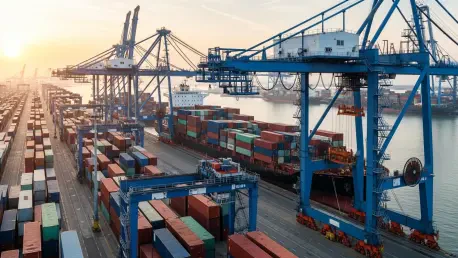

The intricate machinery of American commerce currently faces a defining moment as the intersection of executive trade mandates and shifting global logistics corridors recalibrates how goods reach the domestic market. Major container ports across the United States serve as more than just transit points; they are the primary engines for the retail supply chain and the broader national economy. From the massive complexes in Los Angeles and Long Beach to the bustling docks of New York and New Jersey, these maritime hubs determine the availability and cost of nearly every consumer product. The current year has seen a heightened level of coordination and friction between the federal government, international shipping lines, and the retail sector as all parties attempt to navigate a landscape defined by regulatory flux.
The Current State of the U.S. Maritime Import Landscape
The significance of the primary geographic gateways on the West Coast, East Coast, and Gulf Coast cannot be overstated, as they handle the vast majority of containerized cargo entering the country. These hubs, including Savannah and Houston, are currently operating under a dense regulatory framework that relies heavily on the Trade Act of 1974 and the International Emergency Economic Powers Act. Such mechanisms allow the executive branch to exert significant influence over import volumes and costs, creating a high-stakes environment for market participants who must balance logistics efficiency with shifting federal mandates.
Shifting Dynamics in Containerized Cargo Flow
Emerging Market Drivers and Behavioral Shifts
Retailers have increasingly transitioned toward conservative, reactive inventory management strategies to buffer against sudden executive trade actions. This shift represents a move away from the aggressive stock-building seen in previous cycles, as the prospect of new duties forces a more disciplined approach to procurement. Furthermore, the prevailing sentiment in the industry identifies tariffs as a direct tax on the supply chain, which ultimately erodes discretionary spending by driving up shelf prices for the average consumer. To mitigate these risks, many organizations are pursuing near-shoring and the diversification of their logistics corridors to reduce dependence on volatile international routes.
Statistical Forecasts and Performance Indicators: First Half Trends
The quantitative data for the first half of the year points to a cooling trend, with total container imports projected to reach 12.21 million Twenty-Foot Equivalent Units, marking a 2.5% decline from the previous year. January started with 2.08 million units, but the subsequent months show a more pronounced contraction. March is expected to see a significant dip to 1.91 million units, representing an 11.2% year-over-year decrease. While May and June might show apparent growth with volumes around 2.1 million units, analysts caution that these figures are deceptive because they are measured against the unusually low benchmarks recorded during the previous year.
Navigation of Operational and Economic Obstacles
Managing the volatility of Section 122 duties and potential Section 301 investigations has become a full-time requirement for logistics planners. Businesses are forced to develop strategies that account for sudden cost spikes while maintaining supply chain resilience. This task is complicated by geopolitical sensitivity, particularly regarding tensions in the Middle East that contribute to structural inflation. Even when direct trade routes remain open, the rising cost of maritime fuel and the general uncertainty surrounding global energy prices exert a downward pressure on import feasibility.
The Evolving Regulatory and Legal Environment
Recent judicial oversight has played a pivotal role in shaping executive power, particularly after the Supreme Court addressed the validity of tariffs imposed under emergency economic acts. In response to these legal shifts, the administration has pivoted to Section 122, utilizing a 150-day window for temporary tariffs that serves as a signal for potential further rate escalations. Compliance and security standards remain rigorous, as customs enforcement agencies and new trade investigations continue to refine the rules of international logistics, ensuring that security does not come at the expense of total systemic collapse.
Future Outlook for U.S. Trade and Logistics
Technological and structural adaptations are emerging as the primary tools for offsetting policy-driven slowdowns, with innovation in port efficiency and logistics tracking offering a glimmer of hope. However, the market remains wary of disruptors such as further geopolitical escalations that could drive global oil prices to new heights. Despite the general cooling trend in container imports, certain resilient sectors continue to show promise, particularly those that have successfully integrated automated supply chain solutions to manage overhead costs and maintain inventory availability.
Strategic Summary and Industry Prospects
The intersection of aggressive trade policy and geopolitical instability successfully cooled the import market throughout the recent months. Stakeholders across the maritime and retail sectors recognized that cost-absorption strategies and long-term strategic planning were no longer optional but essential for survival during this period of contraction. The industry moved toward a model that prioritized flexibility over sheer volume, acknowledging that the era of predictable, low-tariff trade had effectively ended. Leaders in the field focused on securing more stable, diversified corridors while investing in the infrastructure necessary to handle sudden shifts in federal policy. Ultimately, the resilience of the domestic supply chain was tested by these uncertainties, yet the capacity for recovery remained evident as businesses learned to operate within the constraints of a more restrictive trade environment.