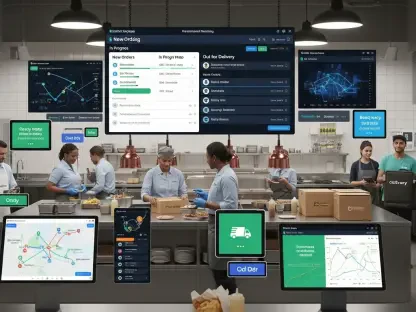

Enterprises today are inundated with vast quantities of data and sophisticated analytical models, yet many struggle to produce outcomes that customers can actually feel. This disconnect highlights a critical shortfall that is not a modeling problem but an execution problem at its core. Recent analysis presented at the Beyond the Map 2025 conference demonstrated how specific human emotions map directly to key business indicators like revenue, retention, and reputation. In practice, this means that if a metric like customer activation is stalling, the solution may not be a larger dataset but a targeted effort to generate momentum. The moment an organization decides what a customer should feel at any given step in their journey, it can strategically design the changes necessary to evoke that emotion and, in turn, watch the corresponding business metric follow suit. This approach transforms abstract data into tangible experiences, creating a powerful link between customer sentiment and concrete business results.
1. A Practical Vocabulary for Feelings
To make emotion an operational tool rather than an abstract concept, teams need a small, shared set of feelings to target and optimize. Extensive research reveals five emotional categories that consistently appear across diverse industries and have a significant impact on business value. The first is Reassurance, which instills confidence that things are on track, a critical feeling during service fixes, insurance claims, or unexpected delays. The second is Ease, representing the low-effort experience desired for routine tasks such as making payments, resetting passwords, or completing bookings. Third is Momentum, the feeling of visible progress toward a meaningful goal, which is essential during customer onboarding, product provisioning, and status updates. The fourth, Significance, is the sense of being recognized and valued at key milestones, like a welcome message, a status upgrade, or a loyalty reward. Finally, Fairness/Trust emerges from transparent treatment and a clear rationale behind decisions, especially in sensitive situations involving pricing, disputes, or cancellations. Each of these feelings is directly paired with a business intent: reassurance reduces rework, ease increases task completion, momentum accelerates activation, significance improves retention, and fairness strengthens reputation.
2. Making Feelings Operational Not Abstract
Feelings become real and impactful only when they drive concrete choices in how daily work is done. On any given Monday morning, an onboarding team lead must be able to answer the question: what should our customers feel right now, and what specific change—in copy, user interface, routing, or policy—will create that emotion? If critical insights about customer frustration or confusion are confined to dashboards, if ownership for each step is ambiguous, or if the strategic framework is too cumbersome to act upon, then nothing will ever shift in the customer’s experience. When progress stalls, the solution isn’t a more complex model but the removal of three common execution blockers that sit between insight and action. The first is that critical signals live far from where decisions are made. The second is ambiguous ownership, where a journey step lacks a named owner and a clear metric, ensuring it will never improve. The third is an overly heavy structure, where complex journey maps may impress executives but fail to guide simple, obvious choices for the teams on the ground. By addressing these blockers, organizations can finally bridge the gap between knowing what customers feel and doing something about it.
3. Zeroing in on the First Win
Building on the principle that specific emotions translate into measurable business value, the most effective way to start is by focusing on one repetitive, high-value step where the target feeling is obvious and the outcome is easy to verify. This approach allows for a quick, demonstrable win that can build momentum for broader adoption. For example, a team could focus on the provisioning process after a B2B sale, targeting Momentum to shorten the client’s “time to first value.” Alternatively, they could analyze activation flows that consistently stall, targeting Ease to reduce friction and minimize hand-offs between systems or departments. Self-service tasks with high abandonment rates are another prime opportunity, where the goal would be to instill Ease and Reassurance by clarifying the next steps and visually showing progress. In customer service, refund or return processes that frequently escalate can be improved by targeting Fairness/Trust, which involves setting clear expectations and providing transparent criteria from the outset. After identifying the target, the next step is to ship the smallest change most likely to evoke that feeling—be it a microcopy update, a UI state adjustment, a minor policy tweak, or a timely human assist—and then immediately observe what the primary business metric did in response.
4. A 90 Day Feelings First Playbook
A structured, three-month plan provides a clear pathway to integrate this emotional framework into daily operations. In the first 30 days, the goal is to define and instrument the target feeling. This involves picking one journey step with both high volume and value, naming the specific emotion for that step, and articulating why it matters (for instance, creating reassurance during a product repair to reduce repeat calls). This feeling is then translated into concrete operational signals, such as whether the customer “knows what happens next” or “sees an ETA.” An owner with decision-making authority is assigned, along with one primary outcome metric and two guardrail metrics to monitor for unintended consequences. In days 31–60, the focus shifts to embedding these signals where work happens. Instead of residing in a separate report, the signals are surfaced directly within the frontline or operations workflow. The team then ships two small changes each week designed to evoke the target feeling, carefully logging each change with its intended feeling and metric linkage. Finally, in days 61–90, the team works to prove and scale the results by comparing the primary metric to its baseline, keeping what works, reverting what doesn’t, and cloning the successful pattern to the adjacent journey step.
5. The Framework for Continuous Improvement
To measure progress effectively, the initial focus should be on establishing clear linkage rather than developing an overly ambitious ROI model. For every change that is implemented, a team must record four critical pieces of information. First is the feeling signal that was tuned, which is ideally a short pulse survey item or a coded verbatim comment tied directly to the journey step. Second is the journey metric that should move first, such as completion rate, time-to-assist, or first-contact resolution. Third is the high-level business metric that leadership values, which aligns with revenue, retention, or reputation. Fourth is the decision record, which clearly documents which insight led to which specific change. As Lufthansa showed at a recent Forrester CX Summit, this methodical approach can evolve from a small service-design team’s effort into a scalable system that connects emotion signals to action across a vast and complex ecosystem. The key lesson is that business outcomes became dependable when teams consistently treated feelings as operational inputs that were defined, instrumented, and reviewed week after week.
6. The Final Shift From Insight to Impact
The organizations that consistently converted customer insights into tangible business actions ultimately mastered three critical disciplines. They adopted a comprehensive journey framework that ensured evidence, ownership, and changes remained intrinsically linked, preventing valuable information from getting lost between teams. They also deliberately simplified their operational structures, stripping away unnecessary complexity so that decision-making became obvious, agile, and focused on the customer’s emotional state. Most importantly, they treated emotion not as an abstract or unpredictable concept but as a practical, measurable input that could be actively tuned and refined week after week. Once that fundamental operating rhythm was established, the improvements that customers could genuinely feel were no longer rare, isolated events. Instead, they became a regular and predictable outcome of their core business operations, cementing a new and lasting standard for customer-centric execution that directly translated sentiment into measurable success.