
Zainab Hussain is a distinguished e-commerce strategist and operations management expert who has spent years at the intersection of customer engagement and sales performance. With a background that blends technical optimization with the human nuances of retail strategy, she provides a unique perspective on how modern organizations can scale their coaching efforts without losing the personal touch that defines successful sales relationships. In an era where sales cycles are growing increasingly complex and teams are distributed across global time zones, Zainab advocates for a sophisticated integration of artificial intelligence and human intuition to drive measurable growth. Our discussion explores the shift from traditional, time-intensive workshops to a hybrid model that combats the “forgetting curve,” streamlines managerial workloads, and ultimately yields significantly higher quota attainment through personalized, methodology-aligned development.
Organizations combining AI and human coaching often see 24% higher win rates and 37% faster onboarding. How do you strike the right balance between these two approaches, and what specific metrics should leaders prioritize to measure the success of a combined strategy?
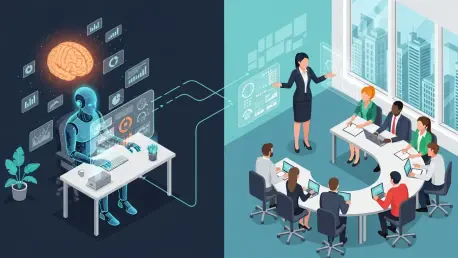
The balance isn’t about dividing time equally between a machine and a person; it’s about leveraging each for its inherent strengths. We see the most success when AI is used to handle the heavy lifting of consistent, daily reinforcement—ensuring that the foundational methodology is applied in every single customer interaction—while the human coach steps in for high-stakes strategic sessions. When you look at the data showing a 24% increase in win rates, it’s clear that this synergy allows reps to master the basics through automation so they can excel in the complex “moments that matter” with their managers. To measure this, leaders should look beyond simple activity logs and prioritize the 3x year-over-year growth in sales quota attainment that typically follows a successful hybrid integration. I also recommend focusing on “ramp time” as a primary metric, as the 37% faster onboarding we see is a direct result of AI providing 24/7 role-play opportunities that a human manager simply cannot provide at that scale. By tracking how quickly a new hire moves from their first training session to their first closed deal, organizations can see the tangible ROI of this combined approach.
Many sales managers spend nearly 70% of their time on tactical tasks like call reviews. How can AI-supported tools specifically offload this administrative burden, and what high-impact strategic activities should managers focus on once that time is reclaimed?
It is a staggering reality that 44% of sales managers admit they don’t have enough time to coach regularly, largely because they are drowning in the tactical 60-70% of their day spent on administrative call reviews and deal tracking. AI-supported B2B coaching tools revolutionize this by utilizing natural language processing to transcribe and analyze conversations instantly, highlighting talk-to-listen ratios, objection handling, and competitor mentions without the manager needing to listen to every minute of audio. Once the AI surfaces these specific coaching moments, the manager is finally free to move away from being a “call checker” and can instead become a true strategist. This reclaimed time should be redirected toward deal strategy for complex accounts, career development planning, and building the emotional intelligence of the team. When a manager can focus on the “why” behind a seller’s behavior rather than the “what” of their daily activity, the entire team’s performance profile shifts, leading to a much higher percentage of top performers across the board.
Humans often forget 70% of new information within 24 hours of receiving it. How does a hybrid model address this “forgetting curve” through daily micro-coaching, and what step-by-step process ensures long-term behavior change across a distributed team?
The “forgetting curve” is the silent killer of traditional sales training, where a massive influx of information during a workshop is lost almost immediately because there is no immediate reinforcement. A hybrid model shatters this curve by replacing or supplementing the one-off two-day workshop with shorter, 90-minute sessions that are immediately followed by AI-driven micro-coaching. The process starts with the AI identifying skill gaps in real-time conversations, which then triggers personalized learning recommendations that the rep can practice in a judgment-free, 24/7 role-play environment. This daily repetition ensures that the methodology becomes a habit rather than a memory, creating a “top-down” adoption where the language of the training becomes the default language of the sales floor. For a distributed team, this means that regardless of time zone or local manager availability, every rep is getting the same high-quality, methodology-aligned feedback every single day, which is the only way to drive permanent behavior change at scale.
Certain demographics prefer human interaction for emotional connection and trust. In what ways does human coaching provide “contextual wisdom” that algorithms lack, and how can a coach adapt their style to build trust with reps who may be skeptical of technology?
While the AI excels at pattern recognition and identifying gaps in a framework, it lacks the ability to “read the room” or understand the deeper motivations that drive human behavior. Research indicates that Gen Z and Gen X sellers, in particular, still prioritize human coaching for that emotional connection and the trust that comes from a shared professional history. Human coaches provide “contextual wisdom” by drawing on decades of experience in real-world competitive battles, allowing them to help a rep navigate a nuanced, high-stakes negotiation where the “right” answer isn’t in a standard playbook. To build trust with skeptics, a coach must position the technology as a supportive tool—an assistant that provides the data—while they remain the advocate who helps the rep interpret that data for their personal growth. By role-modeling the desired behaviors and showing genuine accountability for the rep’s career trajectory, a human coach creates a psychological safety net that no algorithm can ever replicate.
Technology adoption often fails when treated as a simple tool purchase rather than a strategic change. What leading indicators are essential to track during a rollout, and how do you correlate early engagement with lagging results like year-over-year quota attainment?
Success in this space requires a shift from viewing AI as a “software buy” to viewing it as a fundamental change in how the sales organization operates. During the initial rollout, leaders must meticulously track leading indicators such as AI engagement rates, the frequency of coaching interactions, and the improvement in specific skill competency scores generated by the platform. These early signs of engagement are the predictors of future success; for instance, we see that teams combining ongoing coaching with effective training are 63% more likely to produce top performers. By establishing clear baselines before implementation, you can begin to correlate the increase in “talk-to-listen” efficiency or “discovery question” quality directly to lagging indicators like win rates and deal velocity. Ultimately, the correlation becomes undeniable when you see that the reps most active in the AI role-play environments are the same ones driving the 3x year-over-year growth in quota attainment, proving that engagement is the direct precursor to revenue.
What is your forecast for AI sales coaching?
The momentum we are seeing in this sector is undeniable, and I forecast that the AI coaching market will reach a staggering $62.08 billion by 2025 as it moves from being a “nice-to-have” to a core requirement for any competitive B2B organization. We will see a shift where AI moves beyond simple transcription and begins to offer predictive coaching, anticipating deal roadblocks before they even occur based on thousands of historical data points. However, even as the technology becomes more sophisticated, the value of the human coach will actually increase, as their role will be refined to focus entirely on the high-level strategic and emotional work that drives long-term customer loyalty. My advice for readers is to stop viewing AI and human expertise as a binary choice; the future belongs to those who can integrate the scale and consistency of machine learning with the strategic wisdom and trust of human leadership to create a coaching experience that is truly greater than the sum of its parts.