
In a business climate where top-line growth can decelerate to a standstill, the conventional wisdom that links increased sales directly to increased profit begins to crumble, forcing organizations to look inward for financial momentum. For grocery distributor United Natural Foods Inc. (UNFI), this scenario is not a theoretical exercise but a present reality. The company recently demonstrated a significant expansion in profitability even as its quarterly revenue held steady at $7.8 billion, presenting a compelling case study in how operational intelligence can become the primary engine for financial success when the sales engine idles. This achievement was not the result of a market upswing or a sudden surge in demand, but a deliberate and sustained investment in artificial intelligence, automation, and digital transformation.
When Your Sales Hit a Wall Can Your Profits Still Climb
The central paradox facing many modern enterprises is how to generate financial growth in a no-growth environment. For UNFI, the answer lies in shifting the focus from sales volume to operational excellence. When revenue remains flat, the ability to improve margins, reduce waste, and enhance productivity becomes paramount. The company’s performance illustrates that profitability is not solely dependent on selling more products; it is equally, if not more so, dependent on managing the internal mechanics of the business with greater precision and foresight.
This strategic pivot redefines the pathway to financial health. Instead of chasing market share in a saturated landscape, the goal becomes unlocking value that is already latent within the existing operational framework. This approach requires a deep dive into the supply chain, inventory management, and labor efficiency to identify and eliminate the countless small drains on profitability. In this context, technology, particularly artificial intelligence, emerges as the critical enabler, providing the tools to analyze complex systems and make data-driven decisions that directly impact the bottom line.
The Distributors Dilemma Squeezed Margins in a Volatile Supply Chain
The grocery distribution industry operates on notoriously thin profit margins, a reality compounded by intense competition and a volatile supply chain. Distributors like UNFI must navigate a complex landscape of fluctuating demand, transportation costs, and diverse product portfolios. This challenge is exemplified by the company’s recent performance, where a robust 11% year-over-year growth in high-demand natural and organic foods was necessary to offset a decline in conventional product sales. This internal balancing act underscores the constant pressure to optimize every facet of the operation.
In such a challenging market, technology ceases to be a luxury and becomes an essential tool for survival and competitive differentiation. The ability to accurately predict demand for thousands of products, streamline warehouse operations, and accelerate the speed at which new items reach store shelves can mean the difference between profit and loss. For distributors, the strategic implementation of AI and automation is no longer about gaining a slight edge but about fundamentally re-engineering the business to be more resilient, efficient, and responsive to market shifts.
The AI Playbook Unlocking Profit from Within the Operation
A cornerstone of this operational overhaul is the implementation of AI-powered forecasting. By deploying the Relex platform across roughly half of its distribution centers, UNFI has transitioned from a reactive to a predictive inventory management model. This system leverages artificial intelligence to analyze vast datasets and anticipate consumer demand with far greater accuracy. The direct benefits are substantial, including higher fill rates for retail customers, a significant reduction in out-of-stock incidents, and minimized product waste, particularly for perishable goods. These improvements translate directly to more efficient use of working capital.
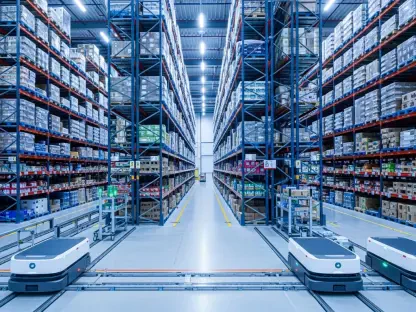
Beyond sophisticated software, physical automation is playing a critical role in enhancing productivity. At its new natural-products distribution center in Sarasota, Florida, advanced automated systems are redefining warehouse workflows. This is complemented by the expansion of a “lean daily management” system to 34 centers, which equips frontline teams with digital tools for rapid, on-the-ground problem-solving. The quantifiable impact of these combined initiatives is clear: the company has boosted its throughput, a key productivity metric, by a notable 10% against figures from two years prior.
The technological transformation also extends to the commercial side of the business, directly impacting how UNFI serves its 30,000 retail customers. The company is actively overhauling its digital support systems for merchandising, pricing, and product assortment. A key achievement has been redesigning supplier workflows, which has dramatically shortened the time it takes for new products from emerging brands to move from onboarding to store shelves. This acceleration not only benefits retail partners but also positions UNFI as a more attractive distributor for innovative new brands.
The Numbers Dont Lie Concrete Evidence of a Tech Driven Turnaround
The connection between UNFI’s strategic technology investments and its improved financial health is direct and measurable. The gains in forecasting accuracy, network automation, and merchandising speed are not abstract concepts; they are the specific drivers behind the company’s enhanced profitability in a flat revenue quarter. This cause-and-effect relationship provides a powerful proof point for the real-world impact of a well-executed digital transformation strategy.
Further reinforcing the sustainability of these gains, the company confidently reaffirmed its full-year revenue guidance. This forward-looking statement signals that the improvements are not a one-time anomaly but the result of a fundamentally stronger and more efficient operating model. UNFI’s progress serves as a compelling case study for the entire industry, demonstrating that the impact of AI on the supply chain has moved from theoretical potential to a practical, bottom-line reality.
A Blueprint for Your Business Four Steps to Replicate UNFIs Success
The journey undertaken by UNFI offered a clear, replicable blueprint for any organization seeking to drive profitability through operational intelligence. The first critical step was to pinpoint the largest operational drags, identifying core processes like forecasting, warehouse labor, or supplier onboarding that were creating the most significant friction and cost. This focused diagnosis ensured that subsequent investments would be aimed at areas with the highest potential for impact.
Next, the strategy centered on deploying a targeted AI solution rather than attempting a broad, unfocused overhaul. The implementation of the Relex platform for inventory management served as a high-impact starting point, addressing a specific, critical pain point with a powerful tool. Following this, the third step was to empower people with technology by implementing digital systems that provided teams with real-time data, enabling them to make smarter, faster decisions on the ground floor. Finally, success was validated by measuring what matters. Tracking specific, relevant KPIs like throughput, fill rates, and working capital efficiency provided the clear return on investment needed to justify the strategy and guide the next phase of technological investment.