
After a period of unprecedented activity that saw container ships lining up for miles off the coast, the rhythm of commerce flowing through America’s ports is showing signs of a significant change. The once-frenzied pace of cargo moving from ship to shore is expected to moderate in the coming months, prompting industry watchers to question whether this shift signals a genuine economic downturn or merely a return to a more sustainable cadence. This period of adjustment follows a remarkable surge, forcing a reevaluation of what “normal” looks like for the U.S. supply chain.
The Lay of the Land: A Snapshot of America’s Busiest Ports
U.S. ports serve as the primary conduits for global trade, acting as critical economic engines that directly influence everything from retail inventory levels to manufacturing output. Their operational efficiency is a barometer for the health of the national economy, with any disruption sending ripples across countless industries. The smooth flow of goods through these gateways is essential for maintaining the delicate balance of supply and consumer demand that underpins economic stability.
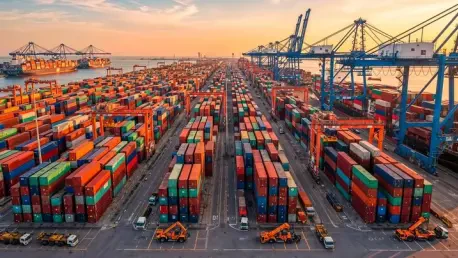
The recent performance of these maritime hubs has been nothing short of historic. In 2025, key West Coast gateways managed record-setting volumes, with the Port of Los Angeles handling an impressive 10.2 million container units, marking its third-best year ever. Its neighbor, the Port of Long Beach, went even further, setting a new all-time record by processing 9.9 million twenty-foot equivalent units (TEUs), including a record 4.8 million imported TEUs, a direct result of aggressive importing strategies by retailers.
Industry analysis and forecasting are heavily guided by leading market observers, most notably the National Retail Federation (NRF) and Hackett Associates. Their joint Global Port Tracker report is a vital resource, providing data-driven insights that help businesses and policymakers anticipate shifts in cargo volume. The projections from these organizations offer a crucial lens through which to interpret the current market dynamics and plan for future logistical challenges.
Charting the Course: Projections and Driving Forces
The Echo of a Surge: Why Past Performance Skews the Present
A significant portion of the current cargo moderation can be traced back to the “frontloading” phenomenon of late 2024 and early 2025. During that time, retailers rushed to import goods far ahead of their usual schedules. This strategic maneuver was driven by a desire to get ahead of potential new trade tariffs and to build a buffer against the uncertainty of possible labor disruptions at the ports, creating an artificial and unsustainable peak in import volumes.
This frontloaded surge is now creating a statistical echo. The natural post-holiday slowdown in shipping, a typical occurrence in the first quarter, is being magnified by the fact that many retailers already have excess inventory on hand. The result is a market correction where current import levels appear unusually low when compared to the inflated figures from the previous year, skewing perceptions of the market’s true health.
By the Numbers: A Data-Driven Forecast for Early 2026
The data for early 2026 points to a consistent trend of year-over-year declines. January saw a brief month-over-month bump to 2.11 million TEUs ahead of the Lunar New Year factory shutdowns in Asia, but this figure was still 5.3% below the previous year. This pattern is projected to continue, with February volumes forecast at 1.94 million TEUs (down 4.6%), March at 1.88 million TEUs (a steep 12.4% drop), and April at 2.03 million TEUs (down 8.1%).
However, the forecast identifies a clear turning point on the horizon. May is expected to break the downward trend, with projected volumes reaching 2.07 million TEUs. This would represent the first year-over-year gain of the year, an increase of 6.2%, signaling that the market may be completing its corrective phase and entering a period of normalization and renewed growth.
Navigating Headwinds: The Primary Challenge of Comparison
The central challenge in interpreting the current state of U.S. ports is the “high-water mark” problem. The record-breaking import volumes of the prior year were not the product of organic economic growth alone but were artificially inflated by external pressures. Consequently, comparing current figures to that unusual peak creates a misleading narrative of decline, making it difficult to assess the underlying strength of consumer demand accurately.
It is therefore crucial to distinguish between a temporary slowdown and a fundamental downturn. A downturn would reflect a true contraction in the economy and a decrease in consumer spending. In contrast, the current scenario appears to be a statistical normalization. The projected dip is less a sign of economic weakness and more a reflection of the supply chain recalibrating after an extraordinary period of strategic over-importing.
The Policy and Labor Effect: How External Pressures Shape Cargo Flow
The anticipation of new trade tariffs acted as a powerful catalyst, compelling shippers to drastically alter their logistics schedules. This policy uncertainty forced companies to make costly decisions to import goods months in advance, disrupting established shipping cycles and pulling forward demand. The result was a massive, front-loaded wave of cargo that strained port capacity and skewed volume data for many months.
Adding to this pressure was the persistent shadow of potential labor disputes. The risk of port strikes created significant anxiety across the supply chain, prompting retailers to build up “safety stock” as a hedge against possible closures. This defensive strategy further contributed to the surge in imports, as businesses prioritized inventory security over just-in-time efficiency, compounding the effects of the tariff-related frontloading.
Peering into the Future: Long-Term Outlook for U.S. Shipping
Looking beyond the short-term statistical dip reveals a more resilient U.S. import market. Once the exaggerated year-over-year comparisons subside, the underlying health of the market, which is ultimately driven by consumer activity, is expected to become more apparent. The current phase is best understood as a necessary rebalancing rather than a long-term signal of distress in the shipping industry.
As the excess inventory from the frontloading period is drawn down, shipping patterns are projected to stabilize and return to a more predictable rhythm. This return to normalcy will allow cargo volumes to align more closely with real-time consumer demand, moving away from the reactive, crisis-driven logistics that defined the previous year. This stabilization should foster a more efficient and less volatile supply chain environment.
The Final Docking: A Temporary Ebb in a Strong Tide
The forecasted moderation in cargo volumes was best understood as a corrective and temporary phase, not an indicator of fundamental economic weakness. It represented the logical conclusion to a period of unprecedented and artificially high import activity, as the market naturally sought equilibrium after a significant disruption.
In retrospect, while the near-term numbers appeared muted, the clear pivot back to growth by mid-year suggested the continued strength and adaptability of the U.S. port system. The episode demonstrated the supply chain’s capacity to absorb external shocks and ultimately realign with underlying economic drivers, reinforcing confidence in its long-term resilience.