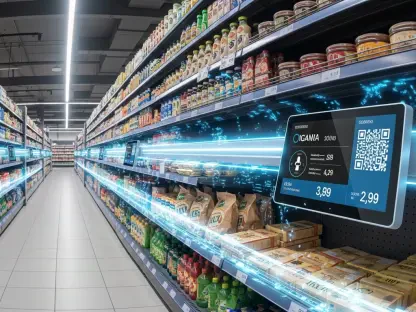

The once-unbreakable retail rule of stocking shelves high with pre-configured computers to meet anticipated demand has been decisively shattered by a strategic maneuver from the world’s most valuable technology company. Apple’s deliberate and large-scale transition to a build-to-order (BTO) system for its Mac line is far more than a simple operational adjustment; it represents a fundamental re-evaluation of the relationship between manufacturing, retail, and the end consumer. This strategic pivot, moving from a philosophy of limited choice to one of mass personalization, is setting a new precedent in an industry long defined by standardized products and speculative production cycles. The aftershocks of this decision are poised to reshape the entire consumer electronics landscape, challenging long-held assumptions about inventory, customer choice, and supply chain efficiency.
The Traditional Retail Model: An Industry Built on Inventory
For decades, the consumer electronics sector operated on a straightforward but risky principle: build-to-stock. Manufacturers would forecast consumer demand months in advance, produce massive quantities of a few standard configurations, and ship them to a global network of warehouses and retail partners. This model prioritized immediate availability, ensuring that a customer could walk into a store and leave with a product the same day. The entire ecosystem, from component suppliers to big-box retailers, was optimized for this high-volume, inventory-heavy approach. Success depended almost entirely on the accuracy of long-range sales predictions, a notoriously difficult task in the volatile technology market.
However, this reliance on inventory created significant financial and logistical vulnerabilities. A substantial amount of capital was perpetually tied up in finished goods sitting on shelves, depreciating in value with each passing day. The most significant risk was “configuration obsolescence,” where the release of a new processor or improved memory component would instantly devalue all existing stock. This forced manufacturers and retailers into a cycle of markdowns and clearance sales to offload outdated products, eroding profit margins. The build-to-stock model, while offering convenience, was an economically inefficient system burdened by the constant threat of miscalculation.
The Catalyst for Change: Forces Driving the Customization Wave
The shift away from this entrenched model was not sudden but rather the result of converging economic, technological, and consumer pressures. The global supply chain disruptions that began earlier this decade served as a powerful catalyst, exposing the fragility of systems dependent on large stockpiles of specific components. Simultaneously, consumer expectations were evolving, influenced by other industries that had long embraced personalization. These forces combined to create an environment where the legacy model of mass production was no longer the most resilient or profitable path forward, paving the way for a more agile, customer-centric approach.
From Mass Production to Mass Personalization: Evolving Consumer Demands
Modern consumers have grown accustomed to tailoring products to their exact specifications, from automobiles and sneakers to personalized news feeds. This desire for personalization has now firmly taken root in the technology space. Buyers, particularly in the professional and creative sectors that form a core part of the Mac user base, increasingly seek machines optimized for their specific workflows. A standard, off-the-shelf configuration is often seen as a compromise, whereas a custom-built machine is viewed as a bespoke tool designed for peak performance in a specific role.
Apple’s BTO system directly addresses this demand by transforming the purchasing process from a simple transaction into an act of co-creation. By allowing customers to select their preferred processor, memory, storage, and other components, the company fosters a deeper connection between the user and the product. This move cleverly reframes the purchase experience, elevating it beyond a mere acquisition of hardware. It taps into a powerful psychological driver, making the customer feel they have invested in a device that is uniquely theirs, thereby strengthening brand loyalty and justifying a premium price point in a competitive market.
The Financial Blueprint: Projecting the Economic Upside of Build-to-Order
The economic rationale for the build-to-order model is compelling and multi-faceted. The most immediate benefit is the dramatic reduction of inventory carrying costs. By manufacturing a Mac only after a customer has paid for it, Apple effectively eliminates the financial burden of storing millions of pre-configured units in warehouses around the world. This just-in-time approach frees up immense capital that would otherwise be locked into depreciating assets, allowing for more strategic investments in research, development, and other growth areas.
Furthermore, this model elegantly solves the chronic problem of configuration obsolescence. In a BTO system, every Mac is assembled using the latest components available at the moment of production, ensuring that no machine is outdated before it even reaches the customer. This not only enhances customer satisfaction but also protects Apple’s profit margins by eradicating the need for costly clearance sales of older inventory. The financial structure shifts from a speculative, high-risk model based on forecasting to a predictable, low-risk model based on confirmed demand, creating a more stable and efficient economic engine.
Hurdles in the New Frontier: Balancing Customization with Convenience
Despite its clear advantages, the transition to a build-to-order system presents a significant challenge: managing customer expectations in an era of instant gratification. The modern retail environment, largely shaped by e-commerce giants offering next-day or even same-day delivery, has conditioned consumers to expect immediate fulfillment. The inherent lead time required to assemble a custom Mac runs directly counter to this prevailing trend. The success of this strategy hinges on Apple’s ability to effectively communicate the value proposition of waiting for a personalized product.
Apple is uniquely positioned to navigate this hurdle due to its powerful brand equity and a customer base that has historically demonstrated a willingness to wait for new product releases. The company’s marketing must frame the delivery timeline not as a delay but as the necessary period for crafting a superior, tailored machine. By emphasizing the benefits of personalization—a device perfectly suited to the user’s needs, built with the latest components—Apple can transform the wait from a point of friction into an anticipated part of the premium experience.
Nevertheless, this approach introduces a competitive vulnerability that rivals can exploit. Competing manufacturers can highlight the immediate availability of their pre-configured systems as a key differentiator, appealing to customers who prioritize speed over customization. The market could see a split where consumers needing a computer immediately will turn to other brands, while those willing to wait for a bespoke solution will gravitate toward Apple’s direct channel. The long-term success of this model will depend on whether the perceived value of personalization consistently outweighs the allure of instant availability for a critical mass of buyers.
The Green Imperative: How On-Demand Manufacturing Aligns with Environmental Stewardship
Apple’s pivot to on-demand manufacturing aligns seamlessly with its broader corporate goals for environmental sustainability. The traditional build-to-stock model is inherently wasteful, as forecasting errors inevitably lead to overproduction. Unsold electronics are a significant contributor to global e-waste, one of the fastest-growing waste streams. By producing a machine only when a customer orders it, the BTO system drastically curtails the creation of surplus inventory, directly reducing the potential for electronic waste and conserving the valuable resources used in manufacturing.
This operational shift also accelerates the adoption of more sustainable technologies. Because each custom Mac is built at the time of order, it is assembled with the most current and energy-efficient components available in the supply chain. This ensures that every new device entering the market represents the latest advancements in power efficiency, reducing the overall carbon footprint of the product lifecycle. This alignment of operational efficiency with environmental responsibility reinforces Apple’s brand image as a leader in sustainability and helps the company make tangible progress toward its ambitious goal of a carbon-neutral supply chain.
The Ripple Effect: How Apple’s Pivot Will Reshape Electronics Retail
The strategic shift toward build-to-order is set to send powerful ripples across the entire electronics retail ecosystem, fundamentally altering Apple’s relationship with its third-party retail partners. A likely outcome is the emergence of a two-tiered market structure. Big-box stores and authorized resellers will continue to play a crucial role by stocking a limited range of the most popular, standard Mac configurations. These locations will cater to customers who value the hands-on experience of trying a product before buying or who require the immediate availability that a BTO system cannot provide.
Simultaneously, Apple’s direct-to-consumer online store will be positioned as the exclusive destination for personalization and customization. This strategy allows Apple to strengthen its direct relationship with its most discerning customers, gathering valuable data on consumer preferences and building a loyal following for its bespoke offerings. For other manufacturers, Apple’s move serves as a powerful proof of concept, potentially prompting them to reconsider their own inventory-heavy models. The industry may see a broader trend toward more flexible, on-demand manufacturing systems, pushing competitors to invest in the sophisticated supply chain and logistics infrastructure required to offer similar levels of customization.
The Final Verdict: A Paradigm Shift in Production and Purchase
Apple’s adoption of a build-to-order model for its Mac computers was not merely an incremental improvement but a decisive paradigm shift that fundamentally re-engineered the process of production and purchase. This strategic pivot marked a calculated departure from the decades-old retail practice of speculative manufacturing, replacing it with a more resilient, efficient, and customer-focused system. By tying production directly to confirmed demand, the company successfully mitigated long-standing financial risks, enhanced its supply chain agility, and catered to a growing consumer appetite for personalized technology.
The move also carried profound implications that extended far beyond Apple’s own operations. It challenged the entire consumer electronics industry to re-evaluate the sustainability and profitability of the traditional build-to-stock model. While the inherent trade-off between customization and convenience presented new challenges in managing customer expectations, the successful implementation of this strategy established a new benchmark for manufacturing excellence. The transition ultimately represented a forward-looking vision for retail, one where waste was minimized, customer choice was maximized, and the final product was a direct reflection of individual need rather than mass-market prediction.