
Travel hubs worldwide have transformed into sprawling retail destinations, dedicating up to 70 percent of their non-aeronautical space to commerce, yet for the millions who pass through them, shopping often remains a peripheral activity rather than a primary engagement. This vast, transient population represents a significant yet largely untapped commercial opportunity. A growing disconnect between the captive audience and its purchasing behavior has prompted industry leaders to question the effectiveness of traditional retail models, turning their attention toward innovative solutions that blend commerce with entertainment.
This challenge has given rise to the concept of “shoppertainment,” a strategy designed to convert passenger boredom into commercial engagement. The core idea is to transform the retail experience from a passive option into an integral part of the travel journey’s entertainment. As companies like SKYdeals expand this model from airline cabins to the broader travel ecosystem, the industry is closely watching to see if making shopping fun is the key to unlocking the true potential of the traveler economy.
The Paradox of the Captive Customer
A fundamental paradox lies at the heart of modern travel retail. Airports, cruise terminals, and train stations hold millions of consumers with disposable income and significant dwell time, yet this captive audience rarely translates into a captive market. Despite the extensive retail infrastructure, shopping is often an afterthought for passengers focused on their destination, leading to stagnant conversion rates that defy the sheer volume of foot traffic.
This commercial inertia is evidenced by the declining relevance of once-staple offerings like the in-flight duty-free catalog, which is rapidly becoming a relic. The central question for operators is no longer about access but about attention. With a world of digital entertainment available on personal devices, the passive display of goods is insufficient to capture the interest of a traveler who is physically present but mentally elsewhere.
Diagnosing the Disconnect From Audience to Consumer
The root of the issue is a fundamental misdiagnosis of the traveler’s state of mind. The industry has long operated under the assumption that a bored traveler is a prime customer, when in fact, they are primarily an uninspired consumer. The underlying need is not for another store, but for a compelling diversion. Travelers are not necessarily broke; they are simply bored by retail experiences that fail to offer novelty or excitement.
This disconnect impacts the entire travel sector, creating a shared challenge for airlines, airports, cruise lines, and rail operators. The traditional model, which presumes that physical proximity to products will drive sales, has proven inadequate. The modern traveler requires an active stimulus to shift from a passive waiting state to an engaged purchasing mindset, a gap that technology-driven entertainment aims to fill.
A Prescription for Engagement Turning Downtime into Playtime
The proposed cure for traveler apathy is “shoppertainment,” a strategy centered on making the act of shopping the entertainment itself. This approach reframes idle time not as a sales opportunity in the traditional sense, but as a period ripe for engaging, game-like commercial experiences. The goal is to transform the transaction into an interaction, making purchasing a memorable part of the journey.
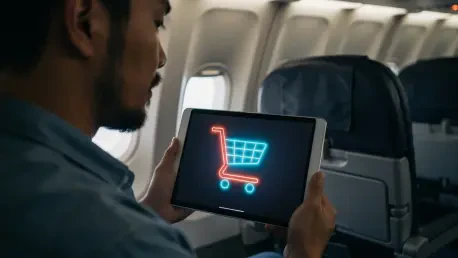
To achieve this, platforms utilize a suite of five psychological levers designed to capture attention and motivate action. These include crafting exclusivity with offers available only during the trip and spurring contextual discovery through location-based “FlyOver Deals.” Furthermore, they manufacture urgency with countdown timers, foster social dynamics via group-buying features, and gamify the purchase with live auctions, turning passive passengers into active participants.
From the Cabin to the Concourse A Proven Concept
This model is not merely theoretical. It has been refined over five years of in-market application with major international carriers, including Air France, Lufthansa Group, and Etihad Airways. These partnerships have served as a crucial testing ground, proving the viability of shoppertainment in the uniquely challenging, low-bandwidth environment of an aircraft cabin. This success in the air has provided a robust proof of concept for its expansion to ground and sea operations.
According to SKYdeals CEO Julien Sivan, mastering the difficult technical constraints of the in-flight experience has prepared the company to deploy its platform in any environment where travelers wait. This experience has been instrumental in positioning the company not as another retailer or marketplace, but as a specialized technology provider. The focus is on empowering partners by integrating shoppertainment mechanics into their existing retail strategies, thereby enhancing their own brand and sales channels rather than competing with them.
Activating the Audience With Two Strategic Paths
For travel retail operators looking to adopt this new strategy, there are practical and flexible pathways to implementation. The goal is to provide accessible solutions that cater to different levels of digital maturity and strategic objectives, allowing businesses to infuse entertainment into their commercial operations without requiring a complete overhaul of their existing infrastructure.
Two distinct partnership models are available to meet these varied needs. The first is a turnkey, white-label e-commerce platform that comes with all the shoppertainment features pre-integrated, offering a ready-to-deploy solution for operators seeking a quick launch. The second option is an integrated approach, providing digital consulting services for businesses that prefer to embed these dynamic, game-like concepts into their own established digital ecosystems, allowing for a more customized evolution of their retail offerings.
The exploration of shoppertainment revealed a critical shift in understanding the modern traveler. It became clear that converting passive dwell time into active commercial engagement required more than just convenient product placement; it demanded an experience. The successful integration of entertainment and retail demonstrated that the cure for disinterest was not a better store, but a more compelling reason to shop. Ultimately, the future of travel retail was defined by its ability to captivate the journey, not just occupy the space within it.